


You’re getting through your days.
Work gets done. People rely on you. Nothing looks broken from the outside.
That’s why this feels confusing.
Because the moment you try to stop—or even reduce—you hit something you didn’t expect.
If you’ve started looking into what safe support actually looks like, this guide to benzodiazepine detox support can help you understand the difference between managing it alone and doing it in a way your body can actually handle.
This isn’t about whether you’re “functional enough.”
It’s about what happens when your system no longer cooperates.
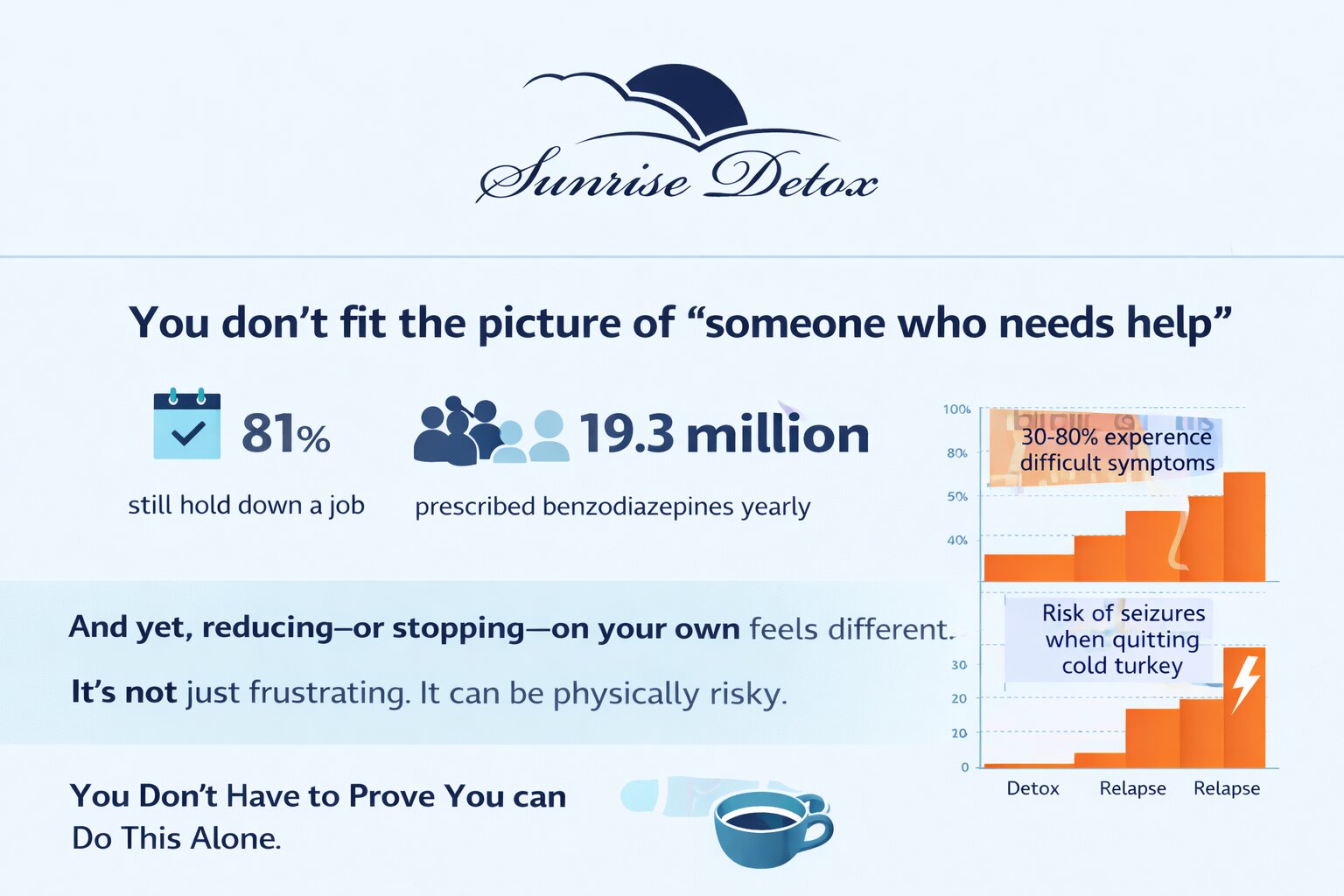
You Don’t Fit the Picture of “Someone Who Needs Help”
Let’s say it plainly.
You don’t see yourself as someone who needs treatment.
You’re not falling apart.
You’re not in crisis.
You’re not identifying with the stereotypes.
And yet—there’s friction.
You’ve probably noticed:
- You plan your day around your dose more than you used to
- You feel it when it wears off
- You’ve thought about cutting back—but haven’t followed through
Not because you can’t.
Because something feels off when you try.
That’s the part most people ignore.
The Plan Feels Rational—Until You Try It
People in your position tend to approach this logically.
You think:
- “I’ll just taper slowly.”
- “I don’t need a full program.”
- “I can manage this myself.”
And to be clear—you might be able to manage a lot.
But benzodiazepines don’t respond to logic the way other things do.
They don’t care how disciplined you are.
They respond to how your brain has adapted.
And once that adaptation is in place, things stop being predictable.
The First Signs Are Easy to Dismiss
It usually doesn’t start with anything dramatic.
It starts quietly:
- Slight restlessness
- A little more anxiety than usual
- Sleep that doesn’t feel restorative
- A sense that something’s just… off
You might push through it. Most people do.
But then it builds.
And at a certain point, pushing through stops working.
This Is Where High-Functioning People Get Stuck
Because you’re capable.
You’ve handled harder things.
You’ve carried more pressure.
You’ve solved bigger problems.
So when this doesn’t respond the same way, it’s frustrating.
And sometimes, a little alarming.
You start to wonder:
- “Why does this feel harder than it should?”
- “Why can’t I just follow through on this?”
It’s not a lack of discipline.
It’s that this isn’t a discipline problem.
Your Nervous System Is Doing Exactly What It Was Trained To Do
Benzodiazepines train your brain to rely on them for calm.
Over time, your baseline shifts.
So when you reduce or stop, your brain doesn’t smoothly transition back.
It reacts.
That’s why trying to follow a xanax taper schedule on your own can feel inconsistent:
- One day feels manageable
- The next feels overwhelming
- Symptoms don’t follow a clear pattern
That unpredictability is what wears people down.
Not weakness. Not lack of effort.
Just a system trying to recalibrate without enough support.
The Hidden Cost of “Pushing Through It”
High-functioning people are good at overriding discomfort.
That skill probably got you far.
But here’s the tradeoff:
When it comes to benzodiazepines, pushing through can:
- Increase anxiety instead of resolving it
- Disrupt sleep further
- Make symptoms feel more intense and less predictable
- Lead to abandoning the taper altogether
It’s like trying to outrun a system that’s wired to slow you down.
Eventually, it catches up.
What Changes With the Right Kind of Support
This isn’t about taking control away from you.
It’s about removing guesswork.
With structured, medical support:
- Adjustments are based on how your body responds—not assumptions
- Symptoms are anticipated and managed
- You’re not left interpreting every change alone
- There’s a steady pace instead of trial and error
For someone like you, that difference matters.
Because you don’t need more pressure.
You need more precision.
The Moment It Stops Being “Optional”
There’s usually a turning point.
Not dramatic. Not public.
Just a quiet realization:
“This isn’t as simple as I thought.”
That moment is easy to ignore.
But it’s also the moment where things can shift—for the better.
Because recognizing complexity doesn’t mean losing control.
It means choosing a smarter way to handle it.
You’re Not Failing—You’re Hitting the Limits of Doing It Alone
This is where I want to be very clear, as someone who’s seen this up close:
You’re not behind.
You’re not weak.
You’re not “bad at this.”
You’ve just reached the point where this requires a different level of support.
And people like you often wait longer than they need to—because everything else in life has always responded to effort.
This is different.
What a Better Approach Actually Feels Like
It doesn’t feel dramatic.
It feels:
- Steadier
- More predictable
- Less reactive
- More manageable over time
You’re not fighting your body every day.
You’re working with it.
And that shift is what makes long-term stability possible.
FAQs About Tapering, Control, and Getting Help
Can I taper off on my own if I’m only taking a small dose?
Sometimes, but it’s not always predictable. Even lower doses can lead to difficult symptoms depending on how long you’ve been taking it.
Why does tapering feel harder than expected?
Because your brain has adapted to the medication. Reducing it changes how your nervous system regulates stress, which can feel destabilizing.
Does needing help mean I’m dependent?
It means your body has adjusted to the medication. That’s a physiological process—not a personal failure.
What makes tapering safer with support?
Monitoring, gradual adjustments, and symptom management. You’re not guessing—you’re following a structured approach.
Will I lose control if I ask for help?
No. The goal is the opposite—to help you regain control in a way that actually works.
How do I know if I’ve reached the point where I need support?
If you’ve tried to cut back and it didn’t go as expected—or you’re hesitant because you suspect it won’t—that’s usually a sign.
You Don’t Have to Prove You Can Do This Alone
You’ve already proven you can handle a lot.
This doesn’t need to be another thing you push through on your own.
If you’re at the point where you’re thinking about doing this differently, call 856-276-0873 or explore your options for treatment in Cherry Hill to learn more about our Benzodiazepine Detox services in Philadelphia.