


I sat in my car longer than I want to admit.
Engine off. Phone in my hand. Staring at the building like it might tell me something I didn’t already know.
I had been here before.
That was the problem.
Because this time, it didn’t feel like courage. It didn’t feel like hope. It didn’t even feel like desperation.
It felt like failure.
If you’re here—looking up options again, maybe even something like getting help for alcohol withdrawal—and feeling that same weight, I get it.
This part is heavier than the first time.
But not for the reasons you think.
The Silence After a Slip Hits Harder Than the Slip Itself
Relapse doesn’t always look dramatic.
Sometimes it’s quiet.
You don’t wake up one day and decide to undo everything. It’s smaller than that. Slower.
You start skipping the things that were keeping you steady. You tell yourself you’re fine. You push away the small warning signs.
Until suddenly, you’re not fine anymore.
And now you’re sitting with something heavier than the drinking itself.
The silence.
The distance from people who thought you were okay.
The voice in your head saying, “You knew better.”
That part lingers longer than the relapse ever did.
The Second Time Feels Personal
The first time, it’s overwhelming.
Everything is new. You’re trying to understand what’s happening, what help looks like, whether you can actually do this.
The second time?
It feels like a reflection of you.
Like this says something about your character. Your discipline. Your ability to change.
That’s what makes it sting.
Because now it’s not just about stopping—it feels like it’s about who you are.
I Thought Going Back Meant I Erased Everything
This was the belief that almost kept me from going back at all.
That if I walked through those doors again, it meant:
- The progress didn’t count
- The time didn’t matter
- The version of me who made it 90 days was gone
That’s not true.
But it feels true when you’re sitting in it.
What I didn’t understand then is this:
You don’t lose growth just because you didn’t hold onto it perfectly.
You still learned something. You still changed in ways that don’t disappear overnight.
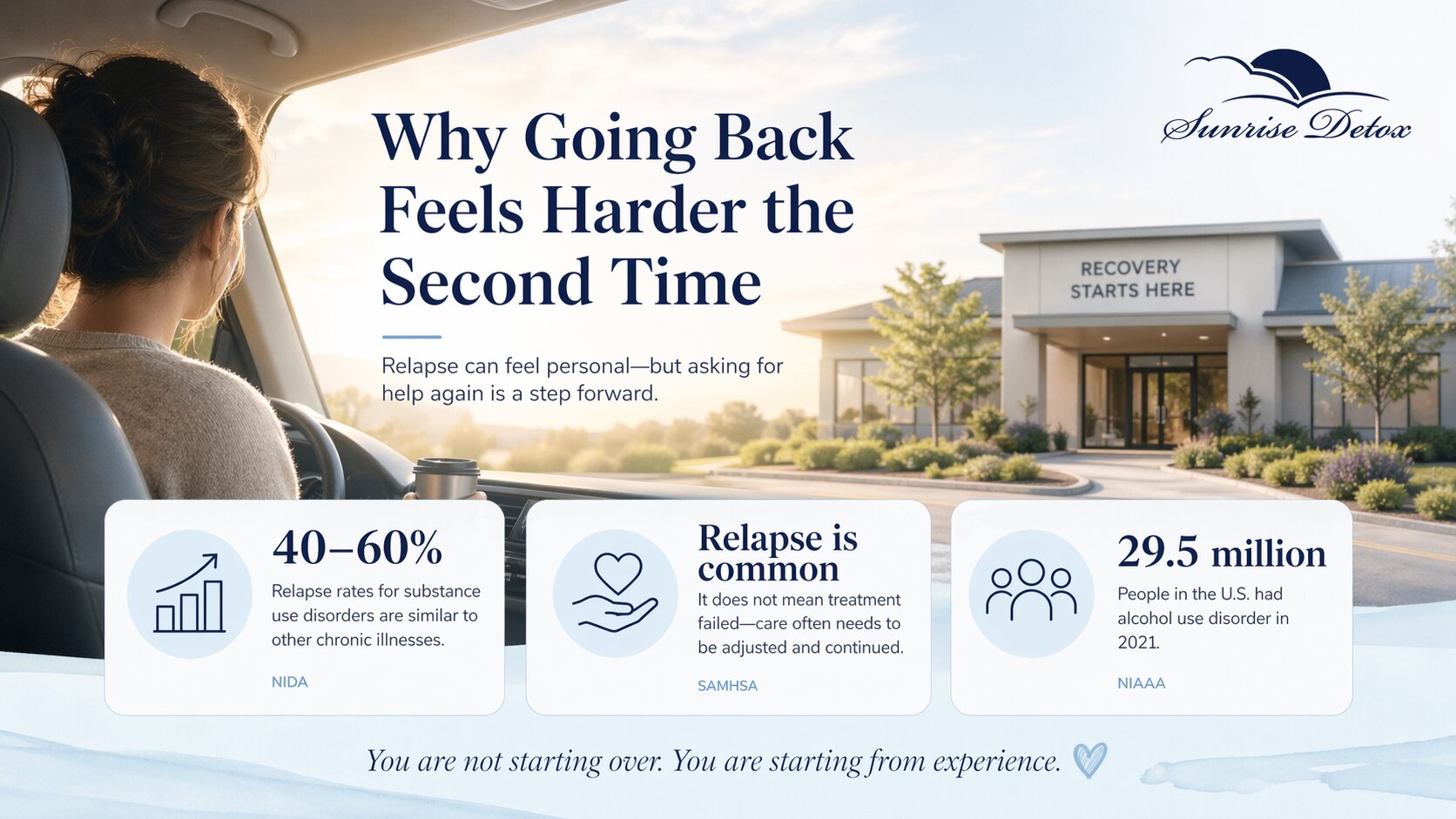
You’re not starting over.
You’re continuing from a place with more awareness.
The Voice in Your Head Gets Louder the Second Time
Let’s not pretend this part is easy.
That voice—the one that tells you:
- You should’ve had this figured out
- You’re wasting people’s time
- You’re just going to end up back here again
It’s louder now.
More convincing.
Because it has “evidence.”
But here’s what I had to learn the hard way:
That voice isn’t insight.
It’s fear trying to keep you from doing something uncomfortable again.
What Actually Changed When I Came Back
It wasn’t the setting.
It wasn’t the structure.
It was the way I showed up.
The first time, I was trying to get out of pain.
The second time, I was forced to look at patterns.
Not just what happened—but why it kept happening.
That shift is uncomfortable.
But it’s also where things start to stick differently.
I Stopped Trying to Do It “Right”
The first time, I cared a lot about how I looked in the process.
I wanted to say the right things. Be seen as someone who was trying. Someone who was getting it.
The second time?
I didn’t have the energy for that.
I was tired of pretending I understood things I didn’t.
So I got more honest.
About what I was struggling with.
About what wasn’t working.
About what I didn’t know how to handle.
That honesty changed everything.
Because it gave me something real to work with.
The Shame Didn’t Go Away—But It Shifted
I won’t lie to you and say the shame disappears.
It doesn’t.
But it changes.
It becomes less about “I am a failure”
and more about “I made a mistake I don’t want to repeat.”
That’s a different kind of weight.
One that you can actually move with.
You Start Seeing Patterns You Missed Before
This is where the second time becomes valuable.
You notice things you didn’t catch before:
- The moments you started disconnecting
- The stress you didn’t address
- The routines you slowly let go of
It’s like watching a replay with more awareness.
Not to beat yourself up.
But to understand what needs to change moving forward.
You’re Not the Only One Who Comes Back
This part surprised me more than anything.
I thought I’d be the only one.
The one who couldn’t hold onto it.
But that’s not what I found.
I found people who had been there before.
People who understood exactly what it felt like to come back.
People who weren’t judging me—because they had their own version of the same story.
That changes the experience.
It takes some of the isolation out of it.
The Meaning of “Starting Again” Changes
The first time, starting feels like a beginning.
The second time, it feels like a decision.
A conscious one.
Not driven by panic—but by awareness.
You’re not just reacting anymore.
You’re choosing to step back into something that can help you stabilize.
That’s a different kind of strength.
Even if it doesn’t feel like it.
If You’re Sitting in That Same Car Right Now
Or staring at your phone. Or going back and forth in your head.
Trying to decide if you can actually do this again.
Let me say this clearly:
Coming back doesn’t mean you failed.
It means you didn’t stop caring about where your life was going.
That matters.
More than getting it perfect the first time ever could.
You Don’t Have to Carry This Alone Again
If you’re considering something like inpatient alcohol withdrawal Cherry Hill, or just looking for a place where you can reset safely without judgment, you don’t have to come in trying to prove anything.
You’ve already done that.
This time can be about understanding yourself better.
Not fixing everything overnight.
Just taking the next step with more awareness than you had before.
FAQ: The Questions That Come Up the Second Time Around
Does going back to detox mean I failed?
No. It means something didn’t hold—and you’re choosing to address it instead of ignoring it. That’s not failure. That’s awareness.
Will it feel harder the second time?
Emotionally, it can feel heavier because of the added shame and expectations. But you also come in with more understanding, which can make the process more effective.
Do people judge you for coming back?
In most cases, no. Many people in recovery have experienced relapse in some form. You’re not as alone in this as it feels.
Am I starting over from zero?
No. You’re starting from experience. You still have the insight, awareness, and progress you built before.
What if I’m afraid I’ll relapse again?
That fear is normal. The goal isn’t perfection—it’s understanding patterns and building stronger ways to respond when things get difficult.
Why does it feel harder to ask for help this time?
Because you’ve already done it once, and there’s pressure to have “gotten it right.” Letting go of that expectation is part of moving forward.
You’re not the only one who’s had to make this decision twice.
Even if it feels like it.
And this time doesn’t have to look like the first.
If you’re looking for treatment in Cherry Hill and need a place to start again—without judgment, without pressure—you don’t have to figure it out on your own.
Call (856) 276-0873 or explore your options for treatment in Cherry Hill to learn more about our alcohol detox services.