


If your child has gone through detox before and is struggling again, something shifts inside you.
The first time, there’s urgency.
The second time, there’s fear.
After that… there’s a quiet kind of exhaustion that’s harder to explain.
You start asking questions you never thought you’d repeat:
How many times can this happen? Is this getting worse? Are we missing something important?
If you’re trying to make sense of it, this guide to alcohol detox support can help you understand what safe, structured care actually looks like—and why detox alone doesn’t always stick.
You’re not behind. You’re in a situation many families face but rarely talk about.
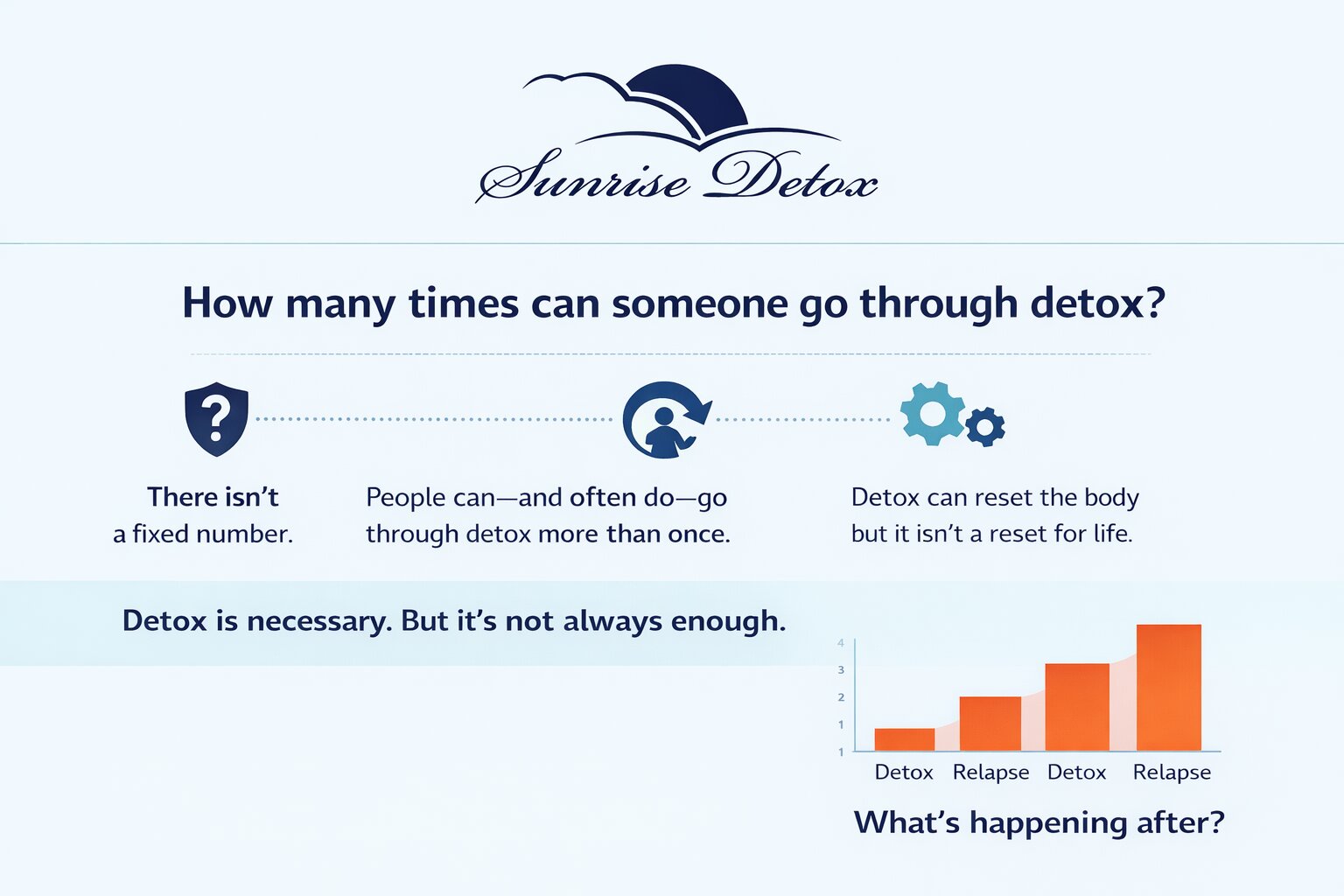
How many times can someone go through detox?
There isn’t a fixed number.
People can—and often do—go through detox more than once.
That doesn’t mean it’s pointless. It doesn’t mean your child isn’t trying.
But it does mean something important is being missed between attempts.
Detox is a reset for the body.
It is not a reset for life.
So when detox keeps happening without something changing afterward, the cycle tends to repeat.
The real question isn’t “how many times?”
It’s: What’s happening after each time?
Why detox alone often isn’t enough
This is where a lot of parents feel confused.
You saw them go through something hard. You saw effort. Maybe even progress.
So why didn’t it last?
Because detox focuses on one piece of a much bigger picture.
It helps your child:
- Get through withdrawal safely
- Stabilize physically
- Clear the immediate effects of alcohol
But once that phase ends, they’re often left facing:
- The same stress
- The same emotional triggers
- The same environment
- The same internal pressure
Just without the thing they were using to cope.
That gap can feel overwhelming—and it’s where many people return to drinking.
Does going through detox multiple times make it more dangerous?
This is a hard but important truth.
For some people, yes.
Repeated withdrawal can become more intense over time. The body doesn’t always “reset” the way we hope it will.
You might notice:
- Symptoms coming on faster
- Stronger anxiety or agitation
- Increased physical discomfort
- More fear around stopping again
This doesn’t mean your child is beyond help.
But it does mean the situation deserves careful, medically guided support—especially moving forward.
Why “just quitting” isn’t always safe
A lot of young adults say, “I’ll just stop.”
And as a parent, part of you wants to believe that’s possible.
But alcohol dependence doesn’t always work that way.
The quit drinking cold turkey dangers are real, especially for someone who drinks regularly:
- Severe withdrawal symptoms
- Risk of seizures
- Dangerous changes in heart rate and blood pressure
- Confusion, disorientation, or hallucinations in some cases
This isn’t about scaring you.
It’s about helping you understand that stopping suddenly isn’t always the safest option—even if the intention is good.
When should you start to worry more seriously?
You’re already worried. That’s natural.
But there are certain patterns that signal it’s time to look at a higher level of care:
- Detox followed by quick relapse
- Drinking to avoid feeling sick rather than to feel good
- Withdrawal symptoms that seem stronger each time
- Increased emotional instability (anxiety, anger, depression)
- Talking about wanting to stop—but being unable to sustain it
These are not signs that your child isn’t trying.
They’re signs that what they’re dealing with has become more complex than willpower alone can solve.
What this feels like as a parent (and why it matters)
Most parents carry this silently.
The thoughts sound like:
- Did I miss something earlier?
- Did I push too hard—or not enough?
- How do I help without making things worse?
There’s a constant balancing act:
Support them—but don’t enable.
Speak up—but don’t push them away.
Stay calm—but inside, you’re anything but.
This emotional tension is real.
And it matters—because how you show up still plays a role.
Not in controlling the outcome.
But in keeping the door open.
What actually changes the pattern
If detox keeps happening, the focus needs to shift.
Not to doing detox again—but to what surrounds it.
What tends to make a difference:
- Continued care after detox (not stopping at stabilization)
- A structured environment, at least for a period of time
- Support that addresses stress, coping, and emotional patterns
- Consistency—not just intensity
This doesn’t have to be overwhelming.
But it does need to be more than a single step.
How to talk to your child without pushing them away
This might be the hardest part.
Because your instinct is to fix it, protect them, stop the cycle.
But pressure often creates distance.
Instead of:
- “Why does this keep happening?”
- “You need to take this seriously”
Try:
- “I can see this is hard. I’m here with you.”
- “We don’t have to figure everything out today—but we can take one step.”
You’re not ignoring the reality.
You’re creating space for them to stay connected instead of shutting down.
Is it still possible for things to turn around?
Yes.
Even after multiple detox attempts.
Even after setbacks.
Especially then.
Because every attempt means your child is still engaging—still trying in some way, even if it doesn’t look like progress yet.
Recovery is rarely linear.
Sometimes it looks like repetition before it looks like change.
And families who stay steady—not perfect, just steady—make more of a difference than they often realize.
FAQs Parents Often Ask
How many times is too many for detox?
There’s no exact number. What matters is whether anything changes after detox. Repetition without follow-up support often leads to the same outcome.
Why does my child relapse so quickly after detox?
Because detox doesn’t address the emotional and behavioral patterns behind drinking. Without support, those patterns come back fast.
Is each detox harder than the last?
For some people, yes. Withdrawal can become more intense over time, which is why medical supervision becomes more important.
Should I let them try quitting on their own?
It depends on their level of use—but quitting suddenly can be risky. It’s safer to have guidance, especially if they drink daily.
How do I know if they need more than detox?
If they’ve tried before and it didn’t last, or if symptoms are getting worse, it’s usually a sign that additional support is needed.
Am I doing something wrong as a parent?
No. This is not caused by one decision or one moment. What matters most is how you show up now—with support, clarity, and care.
What’s the next step if detox hasn’t worked before?
Looking at what comes after. Continued care, structure, and support are what help make detox actually stick.
You’re Allowed to Need Support Too
This isn’t just your child’s experience.
It’s yours too.
The waiting. The worrying. The trying to stay steady while everything feels uncertain.
You don’t have to carry that alone.
If you’re trying to understand what comes next, call 856-276-0873 or explore options for treatment in Cherry Hill to learn more about our alcohol detox services in Philadelphia.