


He sat there for a while before saying it out loud.
“I don’t think I can do this without it.”
Not detox. Not recovery.
Create.
Music was how he made sense of things—late nights, scattered notes, moments of clarity that felt almost sacred. And somewhere along the way, using stopped feeling like a choice and started feeling like part of the process.
So when his body started reacting—when skipping a dose left him restless, foggy, and off—he didn’t just feel physically uncomfortable.
He felt like he was losing access to himself.
If you’ve ever had that thought—What if stopping changes who I am?—you’re not alone. And if you’ve been searching for answers, maybe even wondering why everything feels so wrong when you skip something your body is used to, there’s more going on than just discomfort.
If you’re considering support for opiate recovery, it helps to understand what’s actually happening—both in your body and in your identity.
The Fear Runs Deeper Than People Think
Most people assume the fear is about physical withdrawal.
But for creative, identity-driven people, that’s not the real fear.
The real fear sounds more like:
- What if I can’t feel things the same way?
- What if I lose my edge?
- What if everything becomes… flat?
There’s often a quiet belief underneath it all:
This is part of how I access something important.
And to be fair, it may have felt that way for a long time.
There might have been moments where things flowed easier, where emotions felt more reachable, where the noise in your head softened just enough to let something come through.
So of course letting go feels risky.
You’re not just letting go of a substance. You’re risking your connection to something meaningful.
Why You Feel “Off” Without It
Let’s slow this down and make sense of what your body is doing.
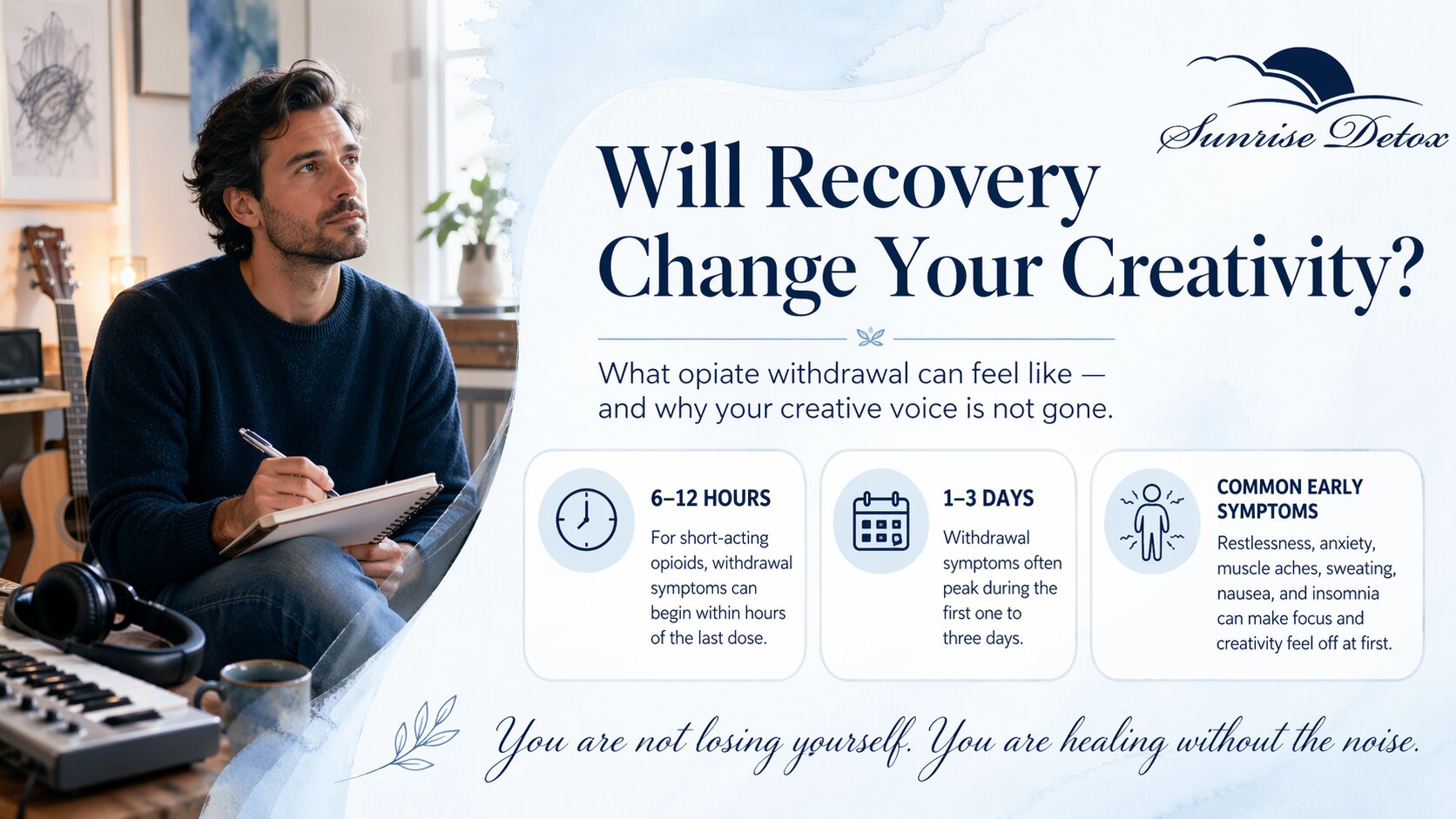
That uneasy, restless, can’t-focus feeling when you skip a dose?
That’s your nervous system reacting.
Those are early opioid withdrawal symptoms, and they don’t just affect your body—they affect your ability to think, feel, and create.
When your system has adapted to something being present, its absence doesn’t feel neutral. It feels disruptive.
So your brain struggles to regulate:
- Focus becomes scattered
- Emotions feel either muted or overwhelming
- Creativity feels blocked or forced
It’s easy to interpret that as “I’ve lost it.”
But that’s not what’s happening.
Your system is adjusting. And adjustment doesn’t feel smooth.
The Creative “Gap” No One Talks About
There’s a phase that many people don’t expect.
It’s not the beginning, and it’s not the end—it’s the middle.
And in that middle, things can feel… quiet.
Not peaceful. Just quieter than you’re used to.
You might notice:
- Ideas don’t come as quickly
- The urgency to create fades
- You second-guess what used to feel natural
This is the part that makes people want to go back.
Because it feels like proof that the fear was right.
But what I’ve seen—over and over—is that this phase is temporary.
It’s not the loss of creativity.
It’s the reset.
What Starts to Come Back (And How It Feels Different)
Creativity doesn’t return in the same form it left.
It changes.
Instead of intensity, there’s clarity.
Instead of urgency, there’s intention.
Instead of chaos, there’s structure.
One person described it this way:
“Before, it felt like I was chasing something. Now it feels like I can actually sit with it.”
That shift can feel unfamiliar at first.
Especially if you’re used to creating from heightened states.
But over time, something steadier develops.
And steadiness is what allows creativity to last.
You Begin to Feel Without Needing to Force It
Substances can amplify certain feelings—but they can also blur others.
In early recovery, emotions don’t always come back all at once. But when they do, they’re often more nuanced.
Less extreme. More layered.
And for someone creative, that matters.
Because real expression doesn’t come from intensity alone. It comes from access.
Access to:
- Subtle emotions
- Quiet moments
- Thoughts that aren’t rushed or distorted
These are the building blocks of meaningful work.
The Work Becomes More Yours
There’s a shift that’s hard to explain until you experience it.
You stop needing something external to unlock creativity.
And instead, you begin to trust your own process.
That doesn’t mean every day feels inspired.
It means the work isn’t dependent on something outside of you anymore.
And that’s a different kind of freedom.
You Don’t Lose Your Identity—You Reclaim It
This is where the fear starts to loosen its grip.
Because what people expect is loss.
What often happens is reconnection.
The parts of you that felt tied to something external start to stand on their own again.
Your voice doesn’t disappear.
It gets clearer.
Your perspective doesn’t flatten.
It stabilizes.
And over time, it becomes something you can rely on—not something you have to chase.
A Moment I Keep Coming Back To
There was a point, a few weeks in, where that same client picked up his notebook again.
No pressure. No expectation.
He wrote a few lines. Then stopped.
Looked up and said, almost confused:
“I didn’t think I could still do that.”
That moment matters more than anything I could explain.
Because it wasn’t dramatic. It wasn’t perfect.
But it was real.
If Part of You Is Still Holding On
You don’t have to rush this.
You don’t have to force yourself to believe something you’re not ready for.
But if there’s even a small part of you wondering whether your creativity could exist without relying on something that’s hurting you—that part deserves attention.
You’re allowed to be curious.
You’re allowed to take this one step at a time.
FAQ: What Creative People Often Ask (But Don’t Always Say)
Will I lose my creativity if I stop using?
No—but it may feel different at first. There’s often an adjustment period where creativity feels quieter before it becomes more stable and intentional.
Why do I feel so mentally blocked without it?
Early opioid withdrawal symptoms can affect focus, mood, and mental clarity. This can temporarily disrupt your creative process, but it’s not permanent.
What if I can only access certain emotions while using?
It can feel that way, especially if you’ve relied on substances to amplify feelings. Over time, those emotions become accessible again—often in a more balanced and sustainable way.
How long does it take for creativity to come back?
It varies. Some people notice small shifts within weeks, while for others it takes longer. What matters is that it does return, often in a healthier form.
Will my work feel less intense or meaningful?
It might feel less chaotic—but not less meaningful. Many people find their work becomes more honest and grounded over time.
What if I’m not ready to give it up yet?
That’s okay. You don’t have to force a decision. But exploring your options and understanding what’s happening in your body can help you make a more informed choice.
You’re not choosing between creativity and feeling better.
You’re choosing whether your creativity gets to exist without something controlling it.
If you’re exploring treatment in Cherry Hill and want to understand what this could look like for you, we’re here to talk—without pressure, without assumptions.
Call (856) 276-0873 or explore your options for treatment in Cherry Hill to learn more about our Opiate Detox services.