


You already feel it.
Not all the time. Not always in a way you can explain. But it shows up when you try to cut back—the shaking, the anxiety, that restless feeling that doesn’t let you sit still in your own body.
And maybe the hardest part isn’t even the symptoms.
It’s the question underneath them:
“How long does this last… and can I actually get through it?”
If you’re here, you probably already know something needs to change. The uncertainty is about how.
If you’re considering alcohol detox support, let’s walk through exactly what happens—not in a clinical way, but in a real, human way—so you know what to expect the moment you walk through our doors.
The Cycle You’re Stuck In Isn’t Your Fault
Let’s name what’s happening clearly.
You try to cut back. Your body reacts. The anxiety spikes. The shakes start. Sleep gets worse. Everything feels louder.
So you drink again—not to feel good, but to feel normal.
That’s not lack of willpower.
That’s your nervous system trying to stabilize itself.
Over time, your body adapts to alcohol being present. So when it’s suddenly not there, everything feels off balance.
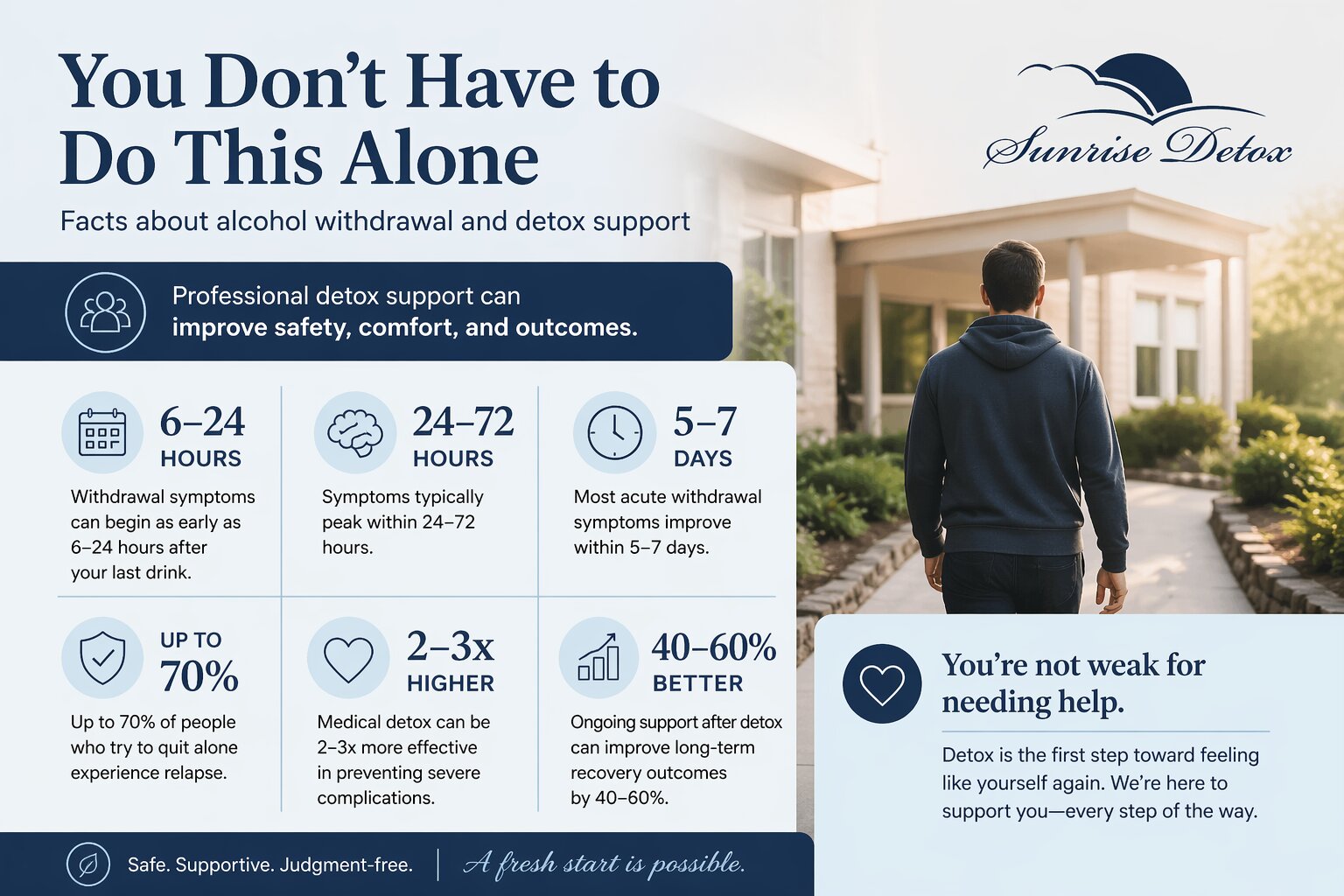
That’s where understanding the alcohol withdrawal timeline matters—not as something you need to memorize, but as a way to understand why your body reacts the way it does.
And more importantly, why doing this alone can feel impossible.
Walking In Doesn’t Feel Like You Expect
Most people imagine this moment wrong.
They picture intensity. Pressure. A spotlight.
But when you walk in, the pace actually slows down.
You’re greeted like a person—not a problem to solve. There’s space to breathe. No one expects you to explain everything perfectly.
Some people come in anxious and talkative. Others are quiet and guarded.
There’s no “right way” to arrive.
You don’t have to prove anything here.
The First Step Is Simple: We Get to Know You
Before anything else, we sit down and understand what your body has been going through.
Not in an interrogative way. In a practical, supportive way.
We’ll ask things like:
- How much you’ve been drinking
- When your last drink was
- What symptoms you’ve noticed when you try to stop
This isn’t about labeling you.
It’s about building a clear picture so we can support your body safely.
Because detox isn’t one-size-fits-all.
Your Body Is Stabilized—Not Tested
This is one of the biggest fears people carry:
“What if I come in and they just let me go through it?”
That’s not what happens.
The focus is stabilization.
As your body begins to adjust, symptoms like anxiety, shaking, sweating, or restlessness are monitored closely. If they increase, they’re addressed early—before they spiral.
Your care team is watching patterns, not just moments. They’re anticipating what your body might need next.
You’re not reacting alone anymore.
The First 24–48 Hours Feel Different Here
This is usually the period people are most afraid of.
At home, this is when symptoms tend to peak. It’s when people feel the most uncomfortable and the most likely to go back just to stop the feeling.
In a supported setting, this window is handled differently.
You’re:
- Checked on regularly
- Supported through symptoms as they arise
- Given space to rest when your body needs it
Instead of guessing what’s happening, you have clarity.
Instead of pushing through, you’re guided through.
That changes the experience completely.
You’re Allowed to Feel Unsure—Even Here
This might surprise you.
You can be in the right place and still feel like:
- What if I can’t do this?
- What if I leave tomorrow?
- What if this isn’t going to work for me?
Those thoughts are normal.
Starting something new—especially something this important—comes with doubt.
We don’t expect confidence on day one.
We expect honesty. And even that can come slowly.
Relief Starts Small—But It’s Real
Most people expect a big moment of relief.
That’s not how it usually happens.
It’s quieter than that.
It might look like:
- A moment where your body isn’t as tense
- A stretch of time where your thoughts slow down
- Realizing you’re not bracing yourself constantly
These small shifts matter.
They’re the first signs your body is starting to settle.
And once that process begins, it builds.
The Mental Load Starts to Lift
Before this, a lot of your energy probably went into managing symptoms.
Planning when to drink. Avoiding discomfort. Trying to control something that kept slipping out of control.
When you’re here, that pressure eases.
Not all at once—but enough to notice.
You don’t have to think five steps ahead just to get through the day.
You don’t have to manage this alone.
That mental space is something people don’t expect—but deeply feel.
You’re Not Locked Into the Future
One of the biggest reasons people hesitate is this:
They think starting detox means committing to everything.
Long-term treatment. Big life changes. A new identity overnight.
That’s not what this step is.
This step is about getting through the beginning safely.
You don’t have to decide everything today.
You don’t have to figure out your whole future.
You just have to take the first step.
A Moment That Happens More Than You’d Think
There’s a point—usually within the first couple of days—where something shifts.
It’s not dramatic.
But someone will pause and say something like:
“I thought this was going to be worse.”
That moment matters.
Because it breaks the fear that kept them stuck.
And once that fear loosens, everything else becomes a little more possible.
If You’re Still Hesitating
That makes sense.
This isn’t a small decision.
But neither is staying where you are.
The symptoms you’re feeling now—the shakes, the anxiety, the constant adjustment—those don’t usually resolve on their own.
They tend to repeat.
And over time, they get harder to manage.
You don’t have to be fully ready.
You just have to be willing to consider that there’s a different way to do this.
FAQ: What People Want to Know Before They Walk In
How long do the shakes and anxiety last when I stop drinking?
It varies, but symptoms often begin within hours and can peak within the first couple of days. With support, they’re managed more safely and comfortably.
Will I be in severe discomfort the whole time?
Not necessarily. Symptoms can be reduced and monitored closely in a professional setting, which makes the process much more manageable.
What happens if my symptoms get worse?
Your care team is there to respond quickly. Adjustments are made based on how your body is reacting, so you’re not left to handle it alone.
Can I leave if I feel like I can’t do it?
You’re not trapped. But most people who feel unsure early on start to feel more stable once support is in place.
Do I need to commit to long-term treatment right away?
No. The focus at the start is getting you through detox safely. Next steps can be discussed when you’re ready.
What if I’ve tried to stop before and couldn’t?
That’s actually very common. It usually means your body needs more support—not that you can’t do it.
You don’t have to keep guessing how this will go.
And you don’t have to keep going through the same cycle alone.
If you’re looking for treatment in Cherry Hill and want to understand what your next step could look like, we’re here to help you take it—at your pace.
Call (856) 276-0873 or explore your options for treatment in Cherry Hill to learn more about our alcohol detox services.