


There’s a specific kind of exhaustion that comes from trying to manage anxiety and alcohol at the same time.
It can look normal from the outside. You still show up to work. You still answer texts. You still laugh at dinner with friends. But internally, everything feels loud. Your thoughts race constantly. Sleep feels impossible without drinking. And somewhere in the middle of all of it, alcohol slowly stops feeling recreational and starts feeling necessary.
A lot of people searching for answers are not searching because they “gave up.” They’re searching because they’re tired of living in survival mode.
If you’ve been exploring support for co-occurring disorders, you may already suspect that anxiety and alcohol are affecting each other in ways that are difficult to untangle alone. You might also be afraid of what getting help actually means.
That fear matters. It deserves honesty, not pressure.
Anxiety and Alcohol Often Become Quietly Connected
For many people, drinking begins as relief.
A couple drinks to calm social anxiety. A few more to finally sleep. Maybe alcohol becomes the only thing that quiets intrusive thoughts long enough to feel normal for a little while.
At first, it can feel manageable.
Then the anxiety starts showing up earlier. Stronger. More unpredictable.
You wake up shaky. Your chest feels tight before work. Your thoughts race in the middle of the night. The same thing that once felt calming now leaves you emotionally raw the next day.
This cycle is incredibly common.
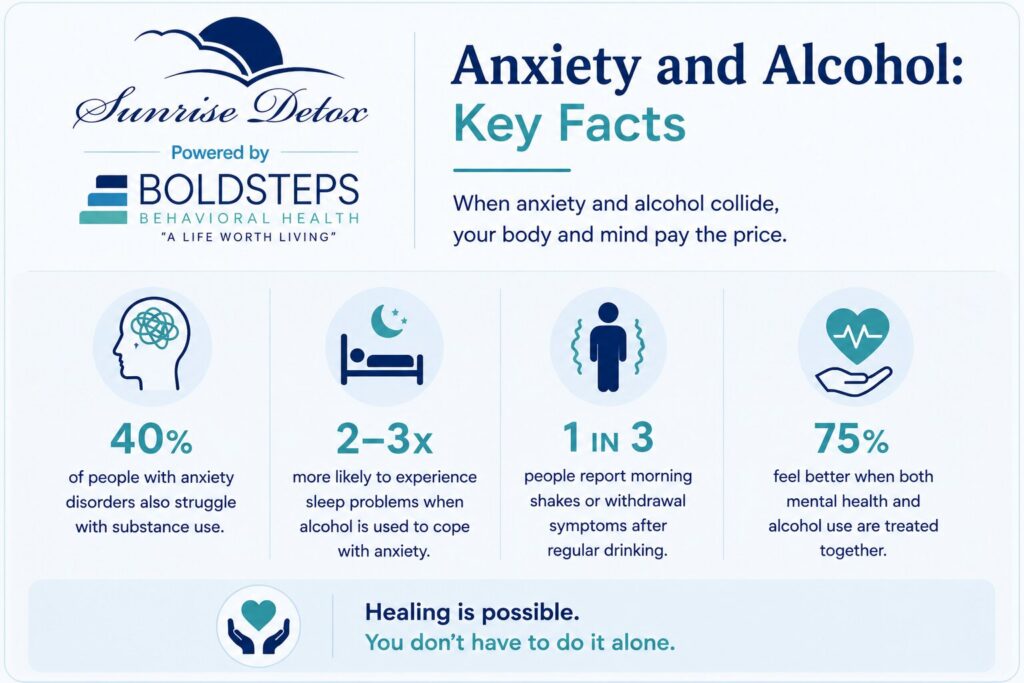
Alcohol can temporarily numb anxiety, but over time it often increases emotional instability, sleep disruption, panic symptoms, and physical stress on the nervous system. People can end up trapped between needing alcohol to calm down and feeling worse because of it.
That’s often what leads someone to search for a dual diagnosis detox near me. Not because they’re dramatic. Because they’ve reached the point where managing both alone no longer feels possible.
You Can Be Struggling Deeply and Still Look “Fine”
One of the hardest things about co-occurring mental health and alcohol use issues is how invisible they can become.
A person may still:
- Go to work every day
- Pay bills on time
- Take care of children
- Maintain friendships
- Look calm in public
Meanwhile, privately, they may be:
- Drinking before social events just to function
- Lying awake until 3am with racing thoughts
- Hiding panic attacks
- Avoiding prescribed medication out of fear
- Feeling emotionally exhausted every single day
People often convince themselves they’re “not bad enough” for treatment because they haven’t completely fallen apart externally.
But suffering does not need to become catastrophic before it deserves attention.
Some people wait years because they think asking for help means admitting weakness. In reality, many treatment conversations begin with someone simply saying, “I don’t think I can keep doing this alone.”
That sentence is enough.
Fear Around Medication Is More Common Than People Realize
A lot of newly diagnosed people are scared of psychiatric medication.
Not because they’re stubborn. Because they’re afraid of losing themselves.
They worry:
- “What if I feel emotionally numb?”
- “What if medication changes my personality?”
- “What if I stop feeling creative?”
- “What if I depend on it forever?”
- “What if people think something is wrong with me?”
Those fears deserve respect.
Good treatment does not force people into silence or blind compliance. A compassionate care team understands that trust takes time, especially for people already struggling with anxiety.
Medication conversations during detox should feel collaborative, not controlling.
Some people benefit from medication immediately. Others need time, education, and emotional safety before making decisions. The goal is not to pressure someone into becoming a different person. The goal is to help reduce suffering enough that healing becomes possible.
That distinction matters.
Detox Is About Safety, Stabilization, and Breathing Room
Many people picture detox as harsh or intimidating. They imagine losing all control overnight.
But medically supervised detox is designed to help people withdraw from alcohol as safely and comfortably as possible while also addressing emotional distress.
For someone experiencing anxiety alongside alcohol dependence, detox may include:
- Medical monitoring during withdrawal
- Emotional support from trained staff
- Help managing panic symptoms
- Conversations about mental health needs
- Rest, hydration, nutrition, and stabilization
- Planning for continued care after detox
A good detox environment understands that mental health symptoms do not magically disappear once alcohol leaves the body.
In fact, early withdrawal can temporarily intensify anxiety. That’s why support matters so much during this phase. People deserve care that treats them like human beings, not problems to solve.
Sometimes healing begins with something surprisingly simple: finally sleeping through the night without fear.
You Don’t Need to Have Everything Figured Out Before Asking for Help
A common misconception is that someone has to be fully committed to lifelong sobriety before entering treatment.
That pressure stops a lot of people from reaching out.
The truth is, many people begin treatment uncertain, overwhelmed, skeptical, or scared.
Some are still trying to figure out:
- Whether alcohol is truly the problem
- Whether anxiety can improve
- Whether treatment will actually help
- Whether they’re capable of change
Those questions are allowed to exist.
You do not need perfect confidence to ask for support.
You do not need to become a motivational speech before making a phone call.
You only need enough honesty to admit something isn’t working anymore.
That’s often where recovery actually starts.
Integrated Support Can Change the Experience Entirely
People struggling with both mental health concerns and alcohol use often feel misunderstood in traditional settings.
They may have been told:
- “Just stop drinking.”
- “Your anxiety will go away eventually.”
- “You’re overthinking it.”
- “You just need more willpower.”
But anxiety is not laziness. Panic is not weakness. Emotional overwhelm is not a character flaw.
Integrated care matters because it recognizes that mental health and substance use affect each other constantly. Treating one while ignoring the other can leave people feeling stuck in the same cycle.
Someone searching for a dual diagnosis detox near me is often searching for more than detox itself. They’re searching for a place where both parts of the struggle are taken seriously at the same time.
That kind of understanding can make it easier to exhale for the first time in a long while.
Recovery Does Not Mean Becoming Someone Else
This fear sits underneath a lot of treatment conversations.
People worry that recovery means becoming flat, boring, overly clinical, or emotionally disconnected from themselves.
Especially for people with anxiety, alcohol can start to feel tied to identity:
- Social confidence
- Creativity
- Relaxation
- Emotional release
- Feeling “normal”
Letting go of alcohol can feel less like losing a habit and more like losing a version of yourself.
But many people eventually discover something surprising.
The parts of them they were afraid of losing were never created by alcohol in the first place.
Their humor. Their personality. Their sensitivity. Their creativity. Their depth.
Those things were already there underneath the exhaustion and panic.
Recovery is not about erasing who you are. It’s about helping your nervous system stop living in constant emergency mode.
And that process rarely happens all at once.
It happens slowly. Quietly. One honest step at a time.
FAQ About Anxiety, Alcohol, and Detox
Can anxiety get worse during alcohol detox?
Yes, temporarily. Anxiety symptoms can intensify during withdrawal because alcohol affects the nervous system. This is one reason medical supervision and emotional support are so important during detox.
Do I have to take medication during detox?
Not necessarily. Treatment decisions are typically discussed collaboratively with medical professionals. Good care respects questions, fears, and individual needs instead of forcing a one-size-fits-all approach.
What if I’m scared treatment will change my personality?
This fear is extremely common, especially for people newly diagnosed with mental health conditions. Effective treatment is meant to help reduce suffering and increase stability — not erase who you are.
Can someone have anxiety and alcohol use issues at the same time?
Yes. Mental health conditions and substance use frequently overlap. Many people drink to cope with anxiety symptoms, only to find the cycle eventually worsens both problems over time.
How do I know if I need detox?
If stopping alcohol causes symptoms like shaking, sweating, panic, nausea, insomnia, or severe anxiety, medical detox may be recommended. A professional assessment can help determine the safest next step.
What happens after detox?
Detox is usually the beginning of treatment, not the entire process. Many people continue with therapy, structured daytime care, outpatient support, or mental health treatment after stabilization.
Is it normal to feel ashamed about asking for help?
Very normal. Many people delay treatment because they feel embarrassed, scared, or convinced they should handle things alone. Reaching out for support is not failure. It’s often the first honest step toward feeling better.
There’s no perfect moment to ask for help.
For many people, it begins quietly. A late-night search. A conversation they almost avoid. A moment of realizing they are exhausted from trying to hold everything together alone.
If anxiety and alcohol have become tangled together in your life, you deserve support that understands both.
Call (856) 276-0873 or visit our co occurring disorders services to learn more about our co-occurring disorders services in Philadelphia.