


Alcohol withdrawal can range from uncomfortable to life-threatening.
While some people experience anxiety, sweating, and tremors, others develop seizures, hallucinations, or delirium tremens (DTs)—a medical emergency that requires immediate treatment. Because withdrawal severity is difficult to predict, healthcare providers often use medications to reduce symptoms and lower the risk of serious complications.
One medication that has received increasing attention is phenobarbital.
Although benzodiazepines remain the most commonly used medications for alcohol withdrawal, some hospitals and medical detox programs also use phenobarbital in carefully selected situations. Both approaches can be effective, but each has unique characteristics that influence how treatment is planned.
At Sunrise Detox Cherry Hill, every withdrawal plan is individualized based on a person’s medical history, current symptoms, and overall risk. Our medical alcohol detox program combines evidence-based treatment with continuous medical monitoring to help patients withdraw from alcohol as safely as possible.
Understanding how phenobarbital fits into alcohol withdrawal treatment can help explain why professional supervision is so important.
What Phenobarbital Is
Phenobarbital is a barbiturate, a class of medications that slows activity within the central nervous system.
Although it has been used for decades to treat seizure disorders, it also has an important role in managing alcohol withdrawal in some medical settings.
Like alcohol and benzodiazepines, phenobarbital affects the brain’s gamma-aminobutyric acid (GABA) system, which helps regulate nerve activity.
During chronic alcohol use, the brain adapts to alcohol’s calming effects.
When alcohol is suddenly removed, the brain can become excessively active, leading to symptoms such as:
- Tremors
- Anxiety
- Elevated heart rate
- High blood pressure
- Hallucinations
- Seizures
Phenobarbital helps reduce this excessive brain activity, lowering the risk of severe withdrawal complications when used under appropriate medical supervision.
Why It’s Used in Alcohol Withdrawal
Healthcare providers may consider phenobarbital because of several characteristics that make it useful during alcohol withdrawal management.
Long-Acting Effects
Phenobarbital has a long duration of action.
Because it remains in the body for an extended period, it can provide relatively consistent medication levels over time.
This may help reduce large fluctuations in symptom control during withdrawal.
Seizure Prevention
One of the primary goals of alcohol withdrawal treatment is reducing the risk of seizures.
Phenobarbital has anticonvulsant properties that can help protect against withdrawal-related seizure activity when used appropriately.
Support for Severe Withdrawal
Some hospitals and detox programs use phenobarbital as part of treatment for patients at higher risk of complicated withdrawal.
Depending on the individual’s clinical situation, it may be used:
- As the primary medication protocol
- Alongside other medications
- When benzodiazepines are not the preferred option
Treatment decisions vary based on each patient’s medical needs and the clinical judgment of the healthcare team.
Consistent Blood Levels
Because of its long half-life, phenobarbital generally maintains more stable blood concentrations than shorter-acting medications.
This characteristic is one reason some clinicians choose it in carefully monitored medical settings.
Phenobarbital vs. Benzodiazepine Protocols
Many people have heard that benzodiazepines such as Librium (chlordiazepoxide), Valium (diazepam), or Ativan (lorazepam) are commonly used for alcohol withdrawal.
That is true.
Benzodiazepines remain the standard treatment in many healthcare settings because they have extensive clinical evidence supporting their use.
However, phenobarbital is also used in certain hospitals and detox centers.
The difference is not that one medication is universally “better” than the other.
Instead, they represent different clinical approaches.
Benzodiazepine-Based Protocols
Benzodiazepines:
- Enhance GABA activity
- Reduce withdrawal symptoms
- Help prevent seizures
- Are commonly administered using symptom-triggered or scheduled protocols
- Have decades of evidence supporting their effectiveness
Phenobarbital-Based Protocols
Phenobarbital:
- Is a barbiturate rather than a benzodiazepine
- Also enhances inhibitory activity within the brain
- Has anticonvulsant properties
- Has a long duration of action
- May be selected for certain patients based on medical history and provider preference
Because treatment protocols differ among hospitals and detox centers, medication selection depends on multiple factors rather than a single standard approach.
The important point is that both approaches require careful medical oversight.
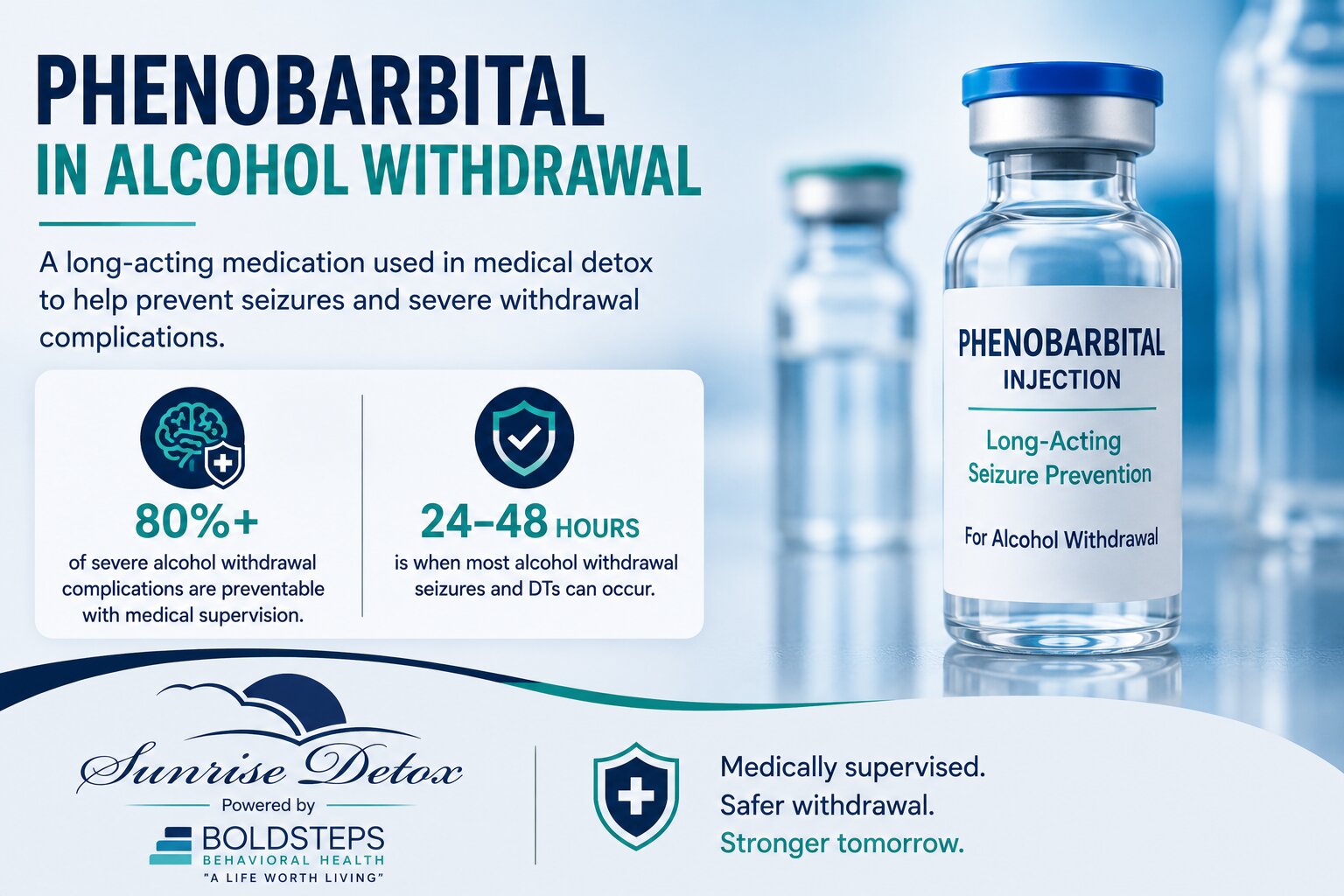
Why Medical Supervision Is Non-Negotiable
Whether alcohol withdrawal is managed with phenobarbital, benzodiazepines, or another evidence-based approach, medical supervision is essential.
Alcohol withdrawal can change rapidly.
A person who initially appears stable may later develop:
- Seizures
- Hallucinations
- Delirium tremens
- Dangerous blood pressure changes
- Rapid heart rate
- Confusion
- Severe agitation
These complications require immediate medical attention.
Phenobarbital itself also requires careful monitoring because it affects the central nervous system.
Healthcare professionals assess factors such as:
- Withdrawal severity
- Level of alertness
- Breathing
- Heart rate
- Blood pressure
- Medical history
- Other medications being taken
Treatment plans are adjusted as symptoms change throughout withdrawal.
This level of monitoring is not possible during an unsupervised home detox.
Why You Should Never Self-Treat with Phenobarbital
Because phenobarbital is a prescription medication with significant effects on the brain and nervous system, it should never be used without medical supervision.
Improper use can increase the risk of:
- Excessive sedation
- Respiratory depression
- Medication interactions
- Overdose
- Complications related to alcohol withdrawal itself
For these reasons, phenobarbital should only be administered as part of a professionally supervised withdrawal plan developed by qualified healthcare providers.
What Medical Alcohol Detox Looks Like at Sunrise
Every patient entering Sunrise Detox Cherry Hill receives a comprehensive evaluation before treatment begins.
Healthcare providers assess:
- Current alcohol use
- Previous withdrawal history
- Prior seizures or delirium tremens
- Medical conditions
- Mental health concerns
- Other substance use
- Current medications
This information helps determine the safest withdrawal plan.
Throughout treatment, patients receive:
Continuous Medical Monitoring
Healthcare professionals monitor:
- Vital signs
- Withdrawal symptoms
- Neurological status
- Hydration
- Overall safety
This allows rapid intervention if symptoms become more severe.
Individualized Medication Management
Medication decisions are based on each patient’s clinical needs.
Depending on the situation, healthcare providers may use evidence-based medications—including phenobarbital in appropriate cases—to help reduce withdrawal symptoms and lower the risk of complications.
Supportive Care
Treatment also includes:
- Hydration
- Nutritional support
- Emotional support
- Rest
- Ongoing assessment throughout withdrawal
Planning for Recovery
Detox is only the beginning.
Before discharge, patients receive recommendations for continued care that may include:
- Residential treatment
- Partial hospitalization (PHP)
- Intensive outpatient treatment (IOP)
- Individual counseling
- Group therapy
- Relapse prevention planning
Continuing treatment helps address the underlying causes of alcohol use disorder after withdrawal has been safely completed.
Recovery Begins with Safe Withdrawal
The goal of medical withdrawal is not simply making people more comfortable.
It is preventing potentially life-threatening complications while creating a strong foundation for ongoing recovery.
Whether treatment involves phenobarbital, benzodiazepines, or another evidence-based approach, the safest outcomes occur when care is provided by experienced medical professionals who can respond quickly as symptoms evolve.
Frequently Asked Questions
Is phenobarbital safe for alcohol withdrawal?
When used by qualified healthcare professionals in an appropriate medical setting, phenobarbital can be a safe and effective option for managing alcohol withdrawal in selected patients. Because it affects the central nervous system and alcohol withdrawal itself can become life-threatening, careful medical monitoring is essential.
How long is a phenobarbital protocol?
The length of treatment varies depending on the individual’s withdrawal severity, medical history, response to treatment, and overall health. Healthcare providers determine the appropriate duration based on ongoing clinical assessment rather than a fixed schedule.
Phenobarbital vs. Librium—what’s the difference?
Phenobarbital is a barbiturate, while Librium (chlordiazepoxide) is a benzodiazepine. Both medications can be used to help manage alcohol withdrawal, but they work somewhat differently and may be chosen based on the patient’s medical needs and the treatment protocol used by the healthcare facility.
Can I take phenobarbital at home for alcohol withdrawal?
No one should begin phenobarbital without medical supervision. Alcohol withdrawal can become unpredictable, and phenobarbital itself requires careful monitoring because of its effects on the brain, breathing, and overall nervous system.
Does phenobarbital cure alcohol addiction?
No. Phenobarbital helps manage withdrawal symptoms during the detoxification process but does not treat alcohol use disorder itself. Long-term recovery typically involves counseling, behavioral therapy, ongoing support, and additional treatment after withdrawal has been safely completed.
Final Thoughts
Phenobarbital has become an important option in some medical settings for managing alcohol withdrawal, particularly because of its long-acting anticonvulsant effects. However, like benzodiazepines, it is only one part of a comprehensive treatment plan—and it should only be used under close medical supervision.
At Sunrise Detox Cherry Hill, we provide individualized alcohol withdrawal care based on each patient’s unique medical needs. Through continuous monitoring, evidence-based treatment, and compassionate support, our team helps patients begin recovery as safely as possible.
If you or someone you love is considering treatment for alcohol dependence, call Sunrise Detox Cherry Hill at 856.276.0873 to learn more about medically supervised withdrawal and recovery options.