


Some people don’t drink because they want to lose control.
They drink because they want relief.
Relief from overthinking. Relief from the pressure in their chest. Relief from feeling too aware of everything all the time. For a few hours, alcohol can feel like someone finally turned the volume down inside your brain.
You stop replaying conversations. You stop worrying about tomorrow. You stop feeling like you have to perform being okay.
Then the next morning comes.
And somehow the anxiety feels sharper than it did before.
For many people, that emotional crash is confusing. If alcohol helps calm anxiety, why does everything feel worse afterward? Why does your body seem to punish you for trying to relax?
This experience is incredibly common, especially for people struggling with when mental health and substance use collide. And no — it doesn’t mean you’re weak, dramatic, or “bad at drinking.”
Sometimes it means your nervous system is tired of surviving this way.
Alcohol Can Feel Like an Emotional Shortcut
People often assume drinking is about fun or recklessness.
But anxiety changes the reason many people reach for alcohol in the first place.
For someone living with chronic stress or anxious thoughts, alcohol can feel less like partying and more like medicine. Not healthy medicine. But immediate medicine.
You may notice things soften after a few drinks:
- Your thoughts slow down
- Social situations feel easier
- Your body unclenches
- You stop overanalyzing every word
- You feel more expressive, emotional, or creative
For some people, it’s the only time they feel fully comfortable in their own skin.
That’s what makes this pattern emotionally complicated.
Because if alcohol feels connected to confidence, creativity, connection, or emotional openness, the idea of stopping can feel terrifying. Especially for people whose identity is tied to being social, funny, artistic, outgoing, or emotionally deep.
A lot of people quietly wonder:
“Who am I without this?”
That question deserves compassion.
Anxiety and Alcohol Often Feed Each Other Quietly
At first, alcohol changes brain chemistry in ways that temporarily reduce feelings of stress or panic. It slows activity in the central nervous system, which is why you may initially feel calmer or more relaxed.
But the brain doesn’t stay in that relaxed state for long.
As alcohol leaves your system, the body tries to rebalance itself. Stress hormones increase. Sleep quality drops. Heart rate can rise. Your nervous system becomes more reactive.
That’s why people often wake up feeling:
- Emotionally raw
- Restless
- Irritable
- Panicky
- Depressed
- Mentally foggy
This is where the anxiety and alcohol cycle begins to build momentum.
You feel anxious, so you drink to calm down.
Then drinking increases anxiety the next day, so you drink again to escape the discomfort.
Over time, the cycle can become emotionally exhausting because it stops feeling like a choice and starts feeling like maintenance.
Not pleasure. Maintenance.
Like constantly trying to stop yourself from emotionally unraveling.
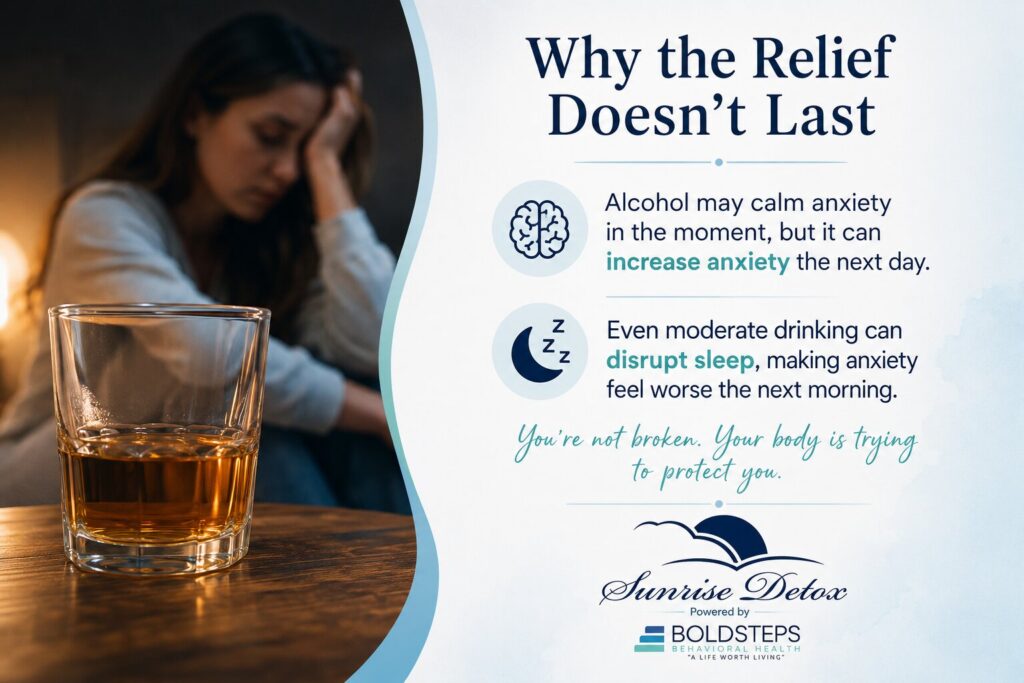
The Emotional Hangover Can Hurt More Than the Physical One
People talk a lot about physical hangovers.
Not enough people talk about emotional hangovers.
Sometimes the hardest part of the next day isn’t nausea or headaches. It’s the dread.
The racing thoughts.
The shame.
The sudden feeling that you embarrassed yourself somehow.
The tightness in your chest for no clear reason.
Even small interactions can suddenly feel unbearable. A text message without a reply can spiral into panic. A normal conversation from the night before gets replayed over and over in your head.
One client once described it this way:
“It felt like my brain turned against me overnight.”
That’s the part many people hide.
Because outwardly, they may still look high-functioning. They go to work. Answer emails. Show up socially. But internally, they’re running on emotional fumes.
And the more often this happens, the more the brain starts associating alcohol with relief — even though it’s also contributing to the suffering afterward.
You Might Not Be “Out of Control” — But You May Be Exhausted
A lot of people delay getting help because they don’t believe their situation is “serious enough.”
They compare themselves to stereotypes.
They think:
- “I still have a job.”
- “I’m not drinking in the morning.”
- “Other people have it worse.”
- “I can stop if I really want to.”
And maybe that’s true.
But functioning and suffering can exist at the same time.
Many people trapped in this cycle are deeply responsible, intelligent, sensitive people who have simply found one coping mechanism that works temporarily — until it doesn’t.
The problem is that anxiety and alcohol tend to slowly shrink a person’s world.
You may start avoiding situations where you can’t drink. Socializing without alcohol feels awkward. Nights without drinking feel emotionally loud. Rest becomes difficult. Your baseline anxiety gets harder to manage naturally.
Over time, your nervous system forgets how to settle on its own.
That isn’t failure. It’s adaptation.
Why Sobriety Can Feel Scary for Creative or Emotional People
One of the most misunderstood parts of recovery is grief.
Not grief for alcohol itself necessarily. But grief for what people believe alcohol gave them.
Confidence.
Connection.
Ease.
Inspiration.
Relief.
For creative or identity-driven people especially, alcohol can feel tied to personality. Some people genuinely fear they’ll become boring, emotionally flat, or disconnected without it.
And honestly? Pretending that fear isn’t real usually pushes people away.
The goal isn’t to shame the part of you that found comfort in drinking.
The goal is to ask whether the comfort is still costing more than it gives.
Many people discover something surprising after getting support:
Their personality didn’t disappear.
Their anxiety just stopped drowning it out.
Real healing often feels less dramatic than people expect. It can look like:
- Sleeping through the night again
- Feeling calm without needing a substance first
- Laughing without forcing it
- Being present in conversations
- Creating from clarity instead of chaos
- Waking up without emotional dread
Not a new personality.
Just less suffering.
Signs This Pattern May Be Affecting You More Than You Realize
Because this cycle often develops gradually, many people normalize it for years.
You may recognize some of these experiences:
- Drinking mainly to feel calmer or more social
- Feeling emotionally worse the day after drinking
- Using alcohol to “take the edge off” regularly
- Feeling anxious about socializing sober
- Struggling to relax naturally anymore
- Worrying you’ll lose part of yourself if you stop drinking
- Promising yourself you’ll cut back, then returning to the same pattern
- Feeling mentally exhausted by the cycle itself
Sometimes awareness starts there.
Not with a crisis.
Just honesty.
Healing Usually Starts With Curiosity, Not Certainty
You do not need to have everything figured out to start asking questions about your relationship with alcohol.
You do not need to hit rock bottom.
You do not need to call yourself an alcoholic.
You do not need to commit to forever.
Sometimes healing begins with a quieter realization:
“I don’t think this is helping me the way it used to.”
That matters.
For people struggling with anxiety alongside alcohol use, getting support that addresses both experiences together can make a significant difference. Treating anxiety without addressing alcohol use often leaves people stuck in the same emotional loop. Treating drinking without understanding the anxiety underneath it can leave people feeling misunderstood.
That’s why integrated support matters.
If you want to explore options for co occurring disorders services, there are people who understand how connected these experiences can feel.
FAQ: Drinking, Anxiety, and Feeling Worse the Next Day
Why does alcohol calm my anxiety at first?
Alcohol temporarily slows activity in parts of the brain connected to stress and hypervigilance. That’s why many people initially feel relaxed, social, or emotionally lighter after drinking.
The problem is that the calming effect is temporary. As alcohol leaves your system, the nervous system becomes more reactive, which can increase anxiety afterward.
Can alcohol actually make anxiety worse long-term?
Yes. Even though alcohol may provide short-term relief, regular drinking can increase baseline anxiety over time. Sleep disruption, nervous system stress, emotional dependence, and withdrawal effects can all contribute to worsening anxiety symptoms.
Is it normal to feel depressed or panicked the day after drinking?
Very normal. Many people experience emotional crashes after drinking, including panic, sadness, irritability, shame, or racing thoughts. This is sometimes called “hangxiety,” though the experience can feel much deeper than a typical hangover.
Why am I scared to stop drinking even if it’s hurting me?
For many people, alcohol becomes emotionally tied to confidence, creativity, relaxation, or social connection. The fear is often less about alcohol itself and more about who you’ll be without it.
That fear is common, especially among highly sensitive, creative, or socially anxious people.
Does needing alcohol to relax mean I’m addicted?
Not necessarily. But it may mean your nervous system has started relying on alcohol as a coping mechanism. If relaxing, socializing, or sleeping feels difficult without drinking, it may help to talk with someone about what’s underneath the pattern.
Can anxiety and substance use be treated together?
Yes. Many people experience both at the same time. Treatment that addresses both mental health and substance use together is often more effective than treating only one side of the issue.
Call (856) 276-0873 or visit our co occurring disorders services to learn more about our co-occurring disorders services Philadelphia.