


I remember sitting there thinking, “Okay, I did it. That should’ve been enough.”
Like I had crossed a finish line nobody else could see.
But a few weeks later, I was right back in the same mental space—just more frustrated, more tired, and honestly… more skeptical.
That’s the part no one really prepares you for.
If you’ve been there, you already know this isn’t about willpower. It’s about understanding what detox actually is—and what it isn’t.
I Thought Detox Was the Whole Solution
The first time I went through detox, I treated it like a cure.
Get stabilized. Push through the worst of the symptoms. Leave. Done.
That was the mindset.
And to be fair, detox did help in a very real way. It got me through the physical withdrawal safely. It gave my body a break.
But I walked out expecting everything else to fall into place automatically.
It didn’t.
Because detox doesn’t rebuild your routines. It doesn’t fix the anxiety underneath. It doesn’t teach you how to sit with discomfort without reaching for something.
It just gets you to a starting point.
The Part Nobody Explains Clearly Enough
Here’s what I wish someone had said in plain terms:
Detox removes the substance. It doesn’t remove the reasons you needed it.
That gap hit me hard.
After I left, I dealt with things I wasn’t ready for:
- Anxiety that felt sharper than before
- Random waves of panic that didn’t make sense
- Sleep that never fully came back online
- That constant feeling like my brain was “too loud”
And because I didn’t understand what was happening, I thought something was wrong with me.
So I did what a lot of people do.
I went back to what I knew would quiet it down.
I Called It Failure—But I Was Missing the Middle
For a long time, I told myself, “Treatment didn’t work for me.”
That belief sticks. It hardens. It makes it harder to try again.
But looking back, I can see something I couldn’t see then:
I didn’t actually go through full treatment.
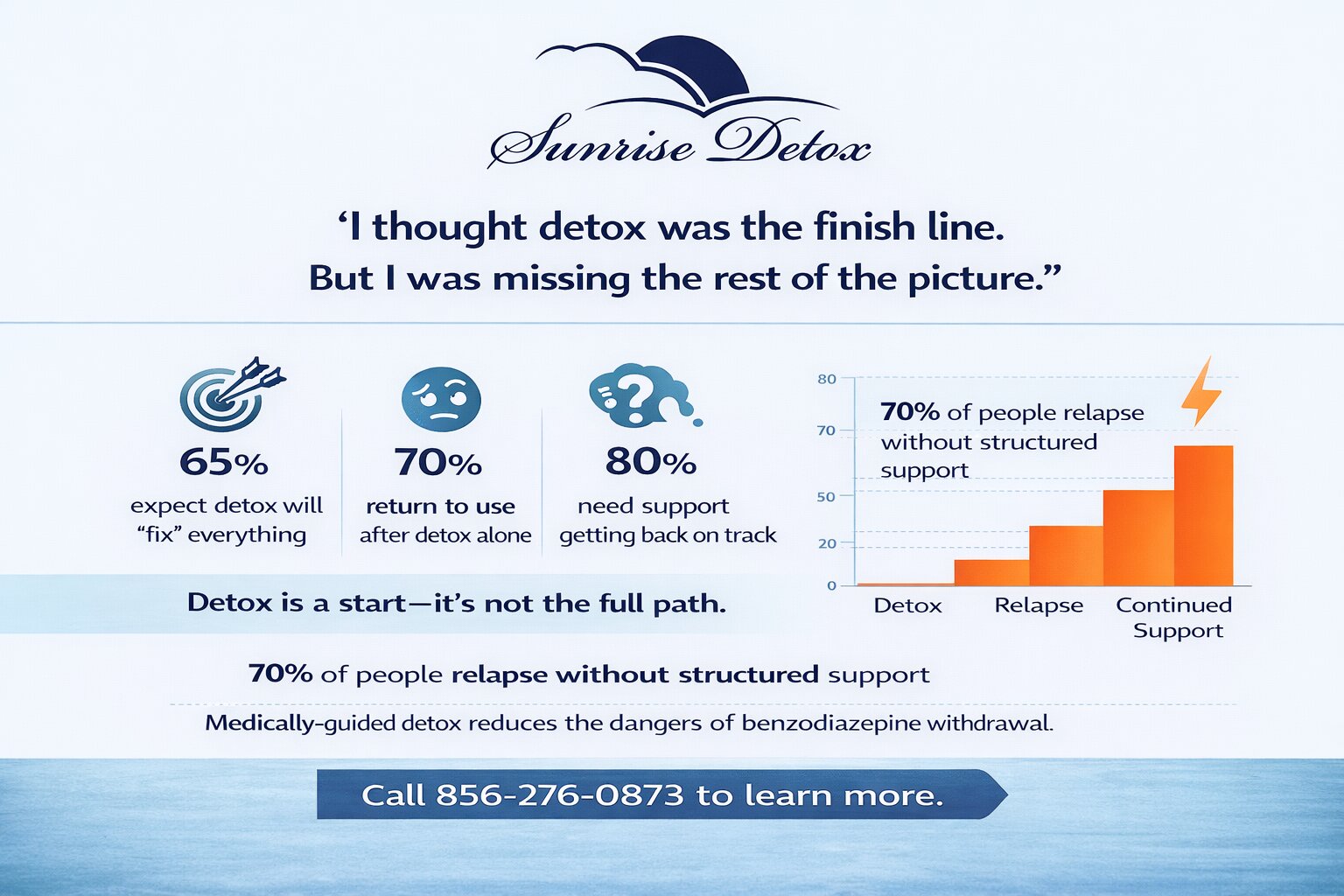
I went through detox—and then stopped.
No step-down care. No consistent support. No structure to catch me when things got unstable again.
That’s like leaving a cast on for a week and expecting a broken bone to heal completely.
It’s not failure. It’s an incomplete process.
Getting Through It vs Learning How to Live Without It
There’s a big difference between:
- Surviving withdrawal
- Building stability after withdrawal
The first one is intense, uncomfortable, and very real. But it’s temporary.
The second one is quieter—and honestly, harder in a different way.
It’s where you learn:
- How to handle anxiety without numbing it
- How to sleep again (even when it’s messy at first)
- How to deal with boredom, stress, and emotions without a quick escape
This part doesn’t feel like a “breakthrough.”
It feels like repetition. Small wins. Some setbacks.
But it’s where recovery actually happens.
Why Benzodiazepines Make This Especially Complicated
Benzos don’t just calm you down—they change how your brain responds to stress and fear.
So when they’re gone, everything can feel amplified.
Not forever. But long enough to make you question everything.
You might notice:
- Your baseline anxiety feels higher
- You react faster to stress
- Your sleep is inconsistent
- Your body feels restless or on edge
That doesn’t mean you’re broken.
It means your nervous system is trying to relearn how to regulate itself.
And doing that without support? That’s where most people struggle.
Searching Again Doesn’t Mean You Failed
I remember the moment I caught myself searching again.
Something like: “benzo withdrawal treatment near me.”
And I hated it.
It felt like proof that I was back at square one.
But I wasn’t.
I had more awareness. More context. More honesty about what didn’t work the first time.
Sometimes going back isn’t regression.
It’s refinement.
If you’re in that place right now—questioning whether it’s even worth trying again—you’re not alone in that thought.
You’re also not stuck in it.
What I’d Do Differently If I Could Start Over
If I could go back, I wouldn’t just ask, “How do I get through detox?”
I’d ask better questions:
- What kind of support happens after detox ends?
- How long does stabilization usually take?
- What if symptoms don’t go away right away?
- Who helps me through that part?
Because the truth is, the hardest days weren’t always the first ones.
Sometimes they came later—when I expected to feel “normal” and didn’t.
That’s where having the right structure makes all the difference.
You’re Not “Bad at Treatment”
That thought—“maybe I just can’t do this”—is more common than people admit.
Especially if you’ve already tried once.
But most of the time, it’s not about being “bad” at treatment.
It’s about:
- Not having the right level of care
- Not staying long enough to stabilize
- Not having support that fits your reality
There’s a difference between something not working—and something not being the right fit or timing.
What Actually Helped Me Understand It Differently
It wasn’t a big breakthrough moment.
It was a quieter realization:
I needed more than just getting off the substance.
I needed help staying off it—and feeling okay without it.
That shift changed how I approached everything.
Not as a one-time fix.
But as something that takes layers.
And once I accepted that, it stopped feeling like I was starting over.
It felt like I was finally doing it fully.
FAQs About Detox, Relapse, and Trying Again
Is it normal to relapse after benzodiazepine detox?
Yes. More common than people think. Detox handles the physical dependence, but without continued support, the mental and emotional side can pull people back.
Does needing detox again mean the first one failed?
Not necessarily. It often means the process didn’t continue long enough beyond detox. Recovery usually requires more than one phase of care.
Why do I still feel anxious after detox?
Because your brain is recalibrating. Benzos affect how your nervous system regulates stress. It takes time—and support—for that to stabilize.
How long does it take to feel normal again?
There’s no exact timeline. Some symptoms improve quickly, others take longer. What matters more is having support during that adjustment period.
What should come after detox?
Ongoing support. That could include structured daytime care, therapy, or continued monitoring—something that helps you stay stable as your system adjusts.
Is it worth trying again if it didn’t work before?
If you’re asking that question, part of you already believes it might be. The difference is approaching it with a clearer understanding of what you actually need this time.
You don’t have to force yourself into blind optimism to try again.
Skepticism is okay. Questions are okay.
But if something in you is saying, “maybe I didn’t have the full picture before,” that’s worth listening to.
Call 856-276-0873 or explore your options for treatment in Cherry Hill to learn more about our Benzodiazepine Detox services in Philadelphia.