


If you’re here, something has already shifted.
Maybe it’s the way they look in the morning.
Maybe it’s the tension in your chest when you hear their voice.
Maybe it’s just that quiet thought: “This feels familiar… and I don’t like it.”
You’re not overreacting.
And you’re not alone in asking this question.
If you want to understand what support can look like at this stage, you can explore alcohol detox support while you read—just to ground yourself in what options exist.
Let’s walk through this carefully, without panic or blame.
How can I tell if this is relapse—or just a one-time slip?
This is often the first question, and it rarely has a clean answer.
A single night doesn’t always mean relapse.
But patterns matter more than promises.
You might notice:
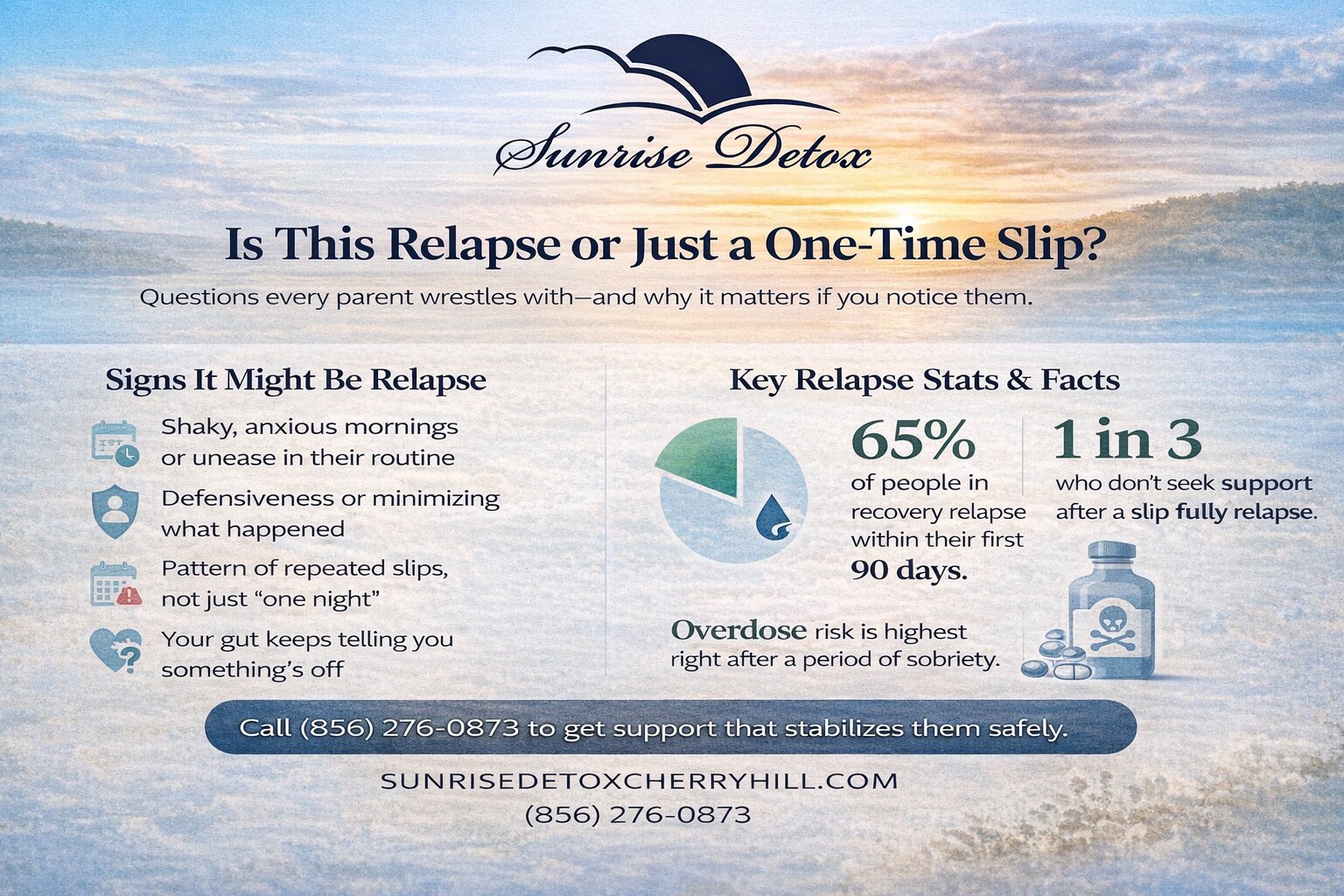
- They minimize what happened (“It was just one night”)
- Their mood or behavior feels off the next day—or longer
- Something in your gut doesn’t settle, even after they explain
Relapse doesn’t always announce itself loudly.
Sometimes it looks like:
- Subtle changes in routine
- Increased defensiveness
- Physical signs that don’t quite add up
As a parent, your instinct is not something to dismiss. It’s data.
Why would this happen after they were doing well?
This is where a lot of parents quietly turn the blame inward.
We got them help. They were better. What changed?
But recovery isn’t about a single fix—it’s about ongoing adjustment.
Your child may still be learning how to:
- Cope with stress without numbing it
- Navigate social pressure
- Sit with emotions that feel overwhelming
Sometimes, when life gets harder, old patterns resurface.
Not because treatment didn’t work.
But because recovery is something people grow into—not something they complete once.
What do those physical symptoms actually mean?
You may notice it most clearly in the mornings.
They wake up shaky.
Their hands tremble slightly.
They seem anxious, unsettled, or unusually irritable.
These alcohol withdrawal shakes can happen when the body has started depending on alcohol and then suddenly doesn’t have it.
And here’s the part that’s hard:
They may not fully understand what’s happening themselves.
They might say they’re fine.
They might brush it off.
But physical symptoms like this are the body’s way of signaling instability.
It’s not just emotional.
It’s physiological.
And that’s something worth taking seriously.
Does needing help again mean we’re back at square one?
No.
It might feel that way—but it’s not true.
Progress doesn’t disappear because of a setback.
Your child still has:
- Awareness they didn’t have before
- Tools they’ve learned (even if they’re not using them right now)
- Experience with what recovery feels like
Coming back for support isn’t starting over.
It’s building on what’s already there.
Sometimes, people need reinforcement—not a reset.
How do I talk to them without pushing them away?
This is one of the most delicate parts.
You want to help—but you don’t want to lose connection.
You might feel the urge to:
- Confront them directly
- Lay out everything you’ve noticed
- Push for immediate action
But intensity can sometimes lead to shutdown.
What often works better is steady, grounded honesty:
“I’m not here to accuse you. I’m here because I’m noticing things that worry me.”
That kind of approach:
- Keeps the door open
- Reduces defensiveness
- Invites conversation instead of conflict
You don’t need perfect words.
You just need to stay connected.
What if they say they don’t need help?
You may hear:
- “It’s not a big deal.”
- “I’ve got it under control.”
- “I don’t want to go back.”
That resistance is often rooted in fear—not defiance.
Fear of:
- Starting over
- Being judged
- Losing independence
You can’t force readiness.
But you can:
- Keep showing up calmly
- Express concern without escalating
- Offer options instead of ultimatums
Sometimes, your consistency matters more than your argument.
How do I support them without losing myself?
This is the part many parents carry quietly.
You’re watching someone you love struggle.
You’re trying to help.
And you’re exhausted.
Supporting your child doesn’t mean sacrificing your own stability.
It can look like:
- Setting boundaries that protect your energy
- Getting your own support system
- Allowing space between you and the outcome
You can care deeply without carrying everything.
That’s not giving up.
That’s sustainability.
When is it time to seriously consider support again?
You don’t have to wait for a crisis.
Early signs matter.
If you’re seeing:
- Repeated drinking patterns
- Physical symptoms like shaking or instability
- Emotional or behavioral shifts
It’s worth exploring support.
Not because things are out of control.
But because they don’t have to get there.
Early intervention often makes everything:
- Safer
- Calmer
- More manageable
FAQ: Questions Parents Often Hold Back
Does relapse mean they didn’t take recovery seriously?
No. Relapse is often part of the recovery process. It doesn’t mean they didn’t care or didn’t try.
Are shaking symptoms something urgent?
They can be. Physical symptoms may indicate the body is struggling to regulate without alcohol, which can require medical attention.
Should I confront them directly about what I’m seeing?
Directness can help—but tone matters. Calm, non-accusatory conversations tend to be more effective than confrontational ones.
What if they refuse to go back to treatment?
You can’t force change, but you can keep communication open, express concern, and seek guidance on how to respond.
Could they need detox again even if it hasn’t been that long?
Yes. If their body has become physically dependent again, support may be needed to stabilize safely.
How do I know if I’m overreacting?
If you’re noticing patterns, physical symptoms, or behavioral changes, you’re responding to real signals—not overreacting.
What’s the most important thing I can do right now?
Stay connected. Stay calm. And don’t carry this alone—get support for both them and yourself.
You’re Not Back Where You Started—Even If It Feels That Way
This moment can feel like everything is unraveling again.
But it’s not the beginning.
It’s a turning point.
You have more awareness now.
More understanding.
More ability to respond—not just react.
And your child?
They’re not starting from zero either.
This is a moment that asks for support—not shame.
If you’re unsure what the next step looks like, you don’t have to figure it out alone.
Call (856) 276-0873 or visit our alcohol detox services to learn more about our alcohol detox services in Philadelphia.