


Many people search how long does Valium stay in your system because they have an upcoming drug test.
Others are asking a very different question.
They are thinking about stopping the medication.
Maybe Valium was prescribed for anxiety, muscle spasms, seizures, or alcohol withdrawal. Perhaps it has been taken for months or years, and concerns about dependence have started to grow. Some people are simply trying to understand why they still feel the medication’s effects long after taking their last dose.
One reason Valium behaves differently than many other benzodiazepines is its unusually long half-life. It stays in the body much longer than many similar medications, which affects everything from drug testing to withdrawal and medical tapering.
At Sunrise Detox Cherry Hill, we help people safely discontinue benzodiazepines through medically supervised care. For individuals who have developed physical dependence, our Valium detox program provides careful monitoring and individualized taper plans designed to reduce withdrawal risks as safely as possible.
Understanding how long Valium remains in the body is an important first step toward understanding why it should never be stopped abruptly.
What Valium (Diazepam) Is
Valium is the brand name for diazepam, a benzodiazepine medication that slows activity within the central nervous system.
Healthcare providers prescribe Valium to treat conditions such as:
- Anxiety disorders
- Muscle spasms
- Seizure disorders
- Alcohol withdrawal
- Certain medical procedures requiring sedation
It works by enhancing the activity of gamma-aminobutyric acid (GABA), a neurotransmitter that helps calm brain activity.
Because of its calming effects and long duration of action, Valium has been widely prescribed for decades.
However, prolonged use can lead to physical dependence, meaning the body gradually adapts to the medication and may experience withdrawal symptoms if it is stopped too quickly.
Valium’s Half-Life and Why It Lingers
One of the defining characteristics of Valium is its exceptionally long half-life.
A medication’s half-life refers to the amount of time it takes for approximately half of the drug to be eliminated from the body.
For Valium, the average half-life typically ranges from 20 to 100 hours, depending on the individual.
In addition, Valium produces active metabolites—particularly desmethyldiazepam (nordiazepam)—that continue affecting the body long after the original medication has been metabolized.
These active metabolites also have long half-lives, extending the medication’s overall presence in the body.
As a result:
- Valium remains in the bloodstream longer than many benzodiazepines.
- Its calming effects may persist after the last dose.
- Withdrawal symptoms often begin later than with shorter-acting benzodiazepines.
- Drug tests may detect Valium for extended periods.
This prolonged activity is one reason healthcare providers sometimes choose Valium when gradually tapering patients off benzodiazepines.
Its slower elimination can produce more stable blood levels, helping reduce abrupt changes that contribute to withdrawal symptoms.
Detection Windows by Test
The amount of time Valium can be detected depends on the type of drug test being used.
Detection windows are approximate and vary based on individual factors.
Urine Test
Urine testing is the most common method used to detect benzodiazepines.
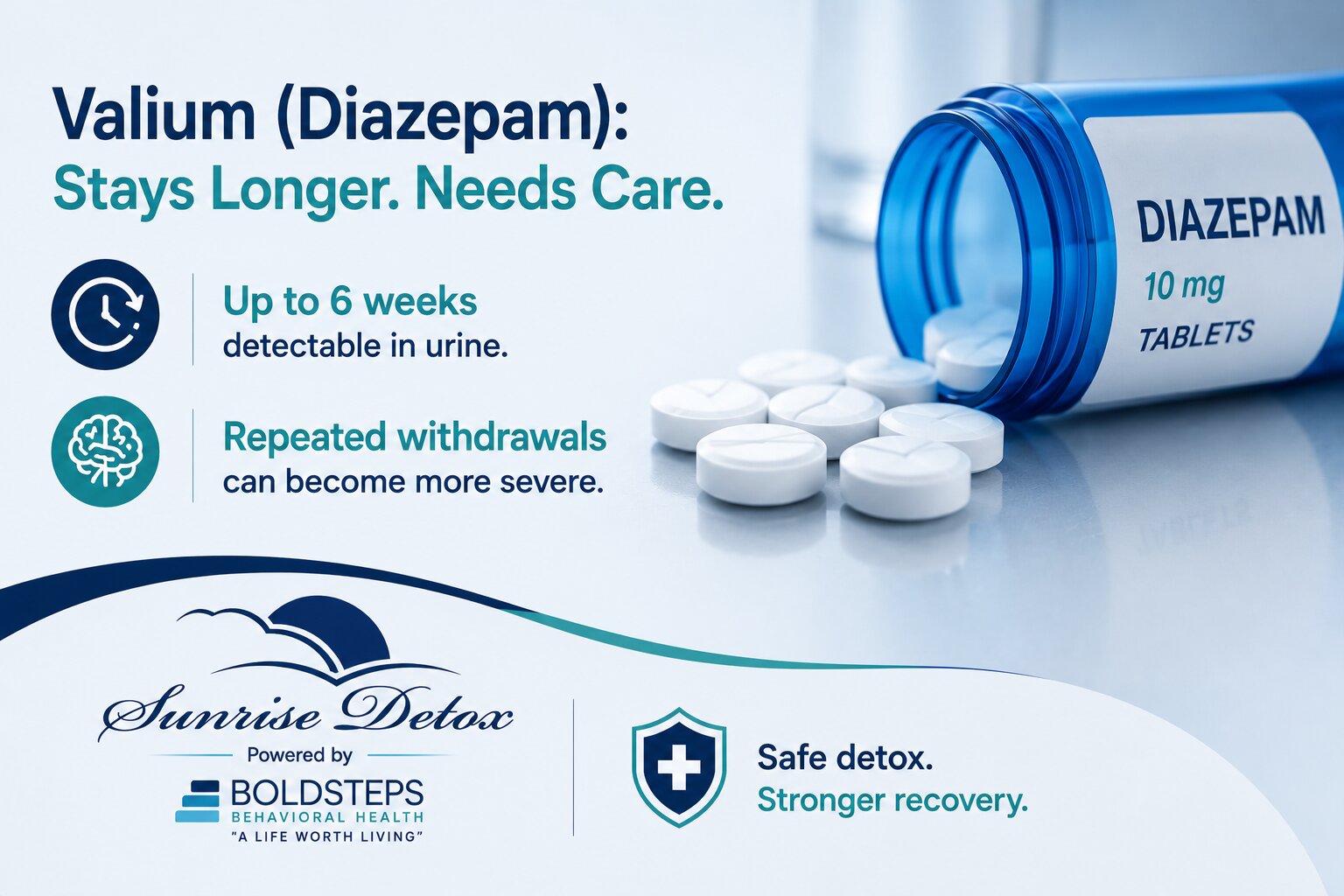
Valium and its metabolites may remain detectable for up to six weeks, particularly after long-term or heavy use.
People who have taken Valium for only a short period may clear it sooner.
Blood Test
Blood tests generally detect Valium for a shorter period.
Typical detection ranges from 6 to 48 hours, although this may vary depending on dose and metabolism.
Saliva Test
Saliva testing typically detects Valium for approximately 1 to 10 days after the last dose.
Detection times vary based on frequency of use and individual metabolism.
Hair Test
Hair follicle testing can identify prior Valium use for up to 90 days after exposure.
Hair testing is generally used to identify long-term patterns of use rather than recent impairment.
Factors That Affect How Long Valium Stays in the Body
No two people eliminate Valium at exactly the same rate.
Several factors influence how quickly the medication and its metabolites are cleared.
Dosage
Higher doses generally take longer to eliminate because the body has more medication to process.
Length of Use
People who have taken Valium regularly for months or years often require more time to fully eliminate the medication than those who used it only briefly.
Age
Older adults often metabolize medications more slowly due to natural changes in liver function and body composition.
As a result, Valium may remain in their systems longer.
Liver Function
The liver plays a major role in breaking down diazepam.
Individuals with liver disease or reduced liver function may eliminate Valium more slowly than healthy adults.
Metabolism
Genetics, overall health, body composition, and metabolic rate all influence how quickly medications are processed.
Some people naturally eliminate Valium faster than others.
Other Medications
Certain prescription medications may slow or alter Valium metabolism by affecting liver enzymes responsible for processing the drug.
Healthcare providers consider potential drug interactions when developing treatment plans.
What Valium’s Long Half-Life Means for a Supervised Taper
Many people assume that because Valium leaves the body slowly, stopping it suddenly is safer than stopping other benzodiazepines.
Unfortunately, that is not the case.
Although withdrawal symptoms often begin later than with shorter-acting benzodiazepines, they can still become severe.
Possible withdrawal symptoms include:
- Anxiety
- Insomnia
- Tremors
- Irritability
- Sweating
- Muscle pain
- Panic attacks
- Hallucinations
- Seizures
For individuals who have developed physical dependence, abruptly discontinuing Valium can be dangerous.
Instead, healthcare providers frequently recommend a gradual taper, allowing the brain and body time to adjust to progressively lower doses.
Because Valium has a long half-life, blood levels tend to decline more gradually, making it useful as part of medically supervised tapering plans in some situations.
However, taper schedules vary based on:
- Current dosage
- Duration of use
- Medical history
- Co-occurring health conditions
- Previous withdrawal experiences
There is no one-size-fits-all taper.
Why Medical Supervision Matters
Stopping benzodiazepines without medical guidance carries real risks.
Unlike withdrawal from many stimulant medications, benzodiazepine withdrawal can become medically serious and, in some cases, life-threatening.
Medical supervision allows healthcare professionals to:
- Monitor withdrawal symptoms
- Adjust taper schedules when needed
- Address complications promptly
- Reduce seizure risk
- Provide supportive care throughout recovery
For individuals taking Valium daily or at higher doses, professional evaluation before stopping the medication is strongly recommended.
Detox Is Only the Beginning
Withdrawal management is an important first step, but long-term recovery often involves much more.
After tapering off Valium, many individuals benefit from continued treatment that addresses the condition for which the medication was originally prescribed.
Depending on individual needs, this may include:
- Cognitive behavioral therapy (CBT)
- Anxiety treatment
- Sleep management strategies
- Medication review
- Stress management techniques
- Ongoing mental health care
Developing a comprehensive treatment plan helps reduce the likelihood of returning to benzodiazepine use while supporting long-term wellness.
Frequently Asked Questions
How long does Valium stay in urine?
Valium may be detectable in urine for up to six weeks, particularly after prolonged or heavy use. Individuals who take lower doses for shorter periods may eliminate the medication more quickly.
Why does Valium stay in your system so long?
Valium has a long half-life and produces active metabolites that continue circulating in the body after the original medication has been processed. These metabolites extend both its effects and its detection window.
What is Valium’s half-life?
Valium’s half-life generally ranges from 20 to 100 hours, although this varies based on factors such as age, liver function, metabolism, and duration of use. Its active metabolites may remain in the body even longer.
Can I stop taking Valium once it leaves my system?
Not necessarily. Physical dependence can develop even when Valium is taken as prescribed. Because benzodiazepine withdrawal can be serious, individuals should never stop taking Valium abruptly without first consulting their healthcare provider.
Why is Valium used during benzodiazepine tapers?
Because Valium remains in the body longer than many other benzodiazepines, it produces more stable medication levels between doses. This can help reduce sudden fluctuations that contribute to withdrawal symptoms during a medically supervised taper.
Final Thoughts
Valium’s long half-life is one of the reasons it is both slow to leave the body and commonly used in medically supervised tapering plans. While this extended duration can help create a smoother reduction in medication levels, it does not eliminate the risks of benzodiazepine withdrawal.
At Sunrise Detox Cherry Hill, we provide medically supervised care for individuals who have become dependent on Valium and other benzodiazepines. Through individualized taper plans, close medical monitoring, and compassionate support, we help patients begin recovery as safely as possible.
If you or someone you love has concerns about long-term Valium use or benzodiazepine dependence, call Sunrise Detox Cherry Hill at 856.276.0873 to learn more about your treatment options.