


If you’re reading this, chances are you’ve been asking yourself a question that many people quietly wrestle with:
“Can I stop taking Ativan on my own, or do I need medical help?”
It’s a reasonable question.
For many people, Ativan didn’t start as a problem. It started as a solution.
Maybe it was prescribed for anxiety. Maybe it helped during a stressful season of life. Maybe it allowed you to sleep, function at work, or get through difficult situations when everything felt overwhelming.
Then something changed.
You began wondering what would happen if you stopped.
Perhaps you’ve noticed yourself relying on it more often than before. Maybe you’ve missed a dose and felt uncomfortable. Maybe you’ve searched online and found stories ranging from mild symptoms to frightening medical emergencies.
Now you’re trying to figure out where you fit into that picture.
At Sunrise Detox Cherry Hill, we speak with many people who are not necessarily looking for treatment yet. They are looking for clarity.
They want honest answers.
They want to understand the difference between discomfort and danger.
And most importantly, they want to know how to make a safe decision.
If you’ve been researching options, learning about benzodiazepine detox treatment can help provide context about what professional support may involve and when it may be appropriate.
Below are some of the most common questions people ask when they’re trying to decide whether medical help is necessary.
Why Are People So Concerned About Stopping Ativan?
The short answer is uncertainty.
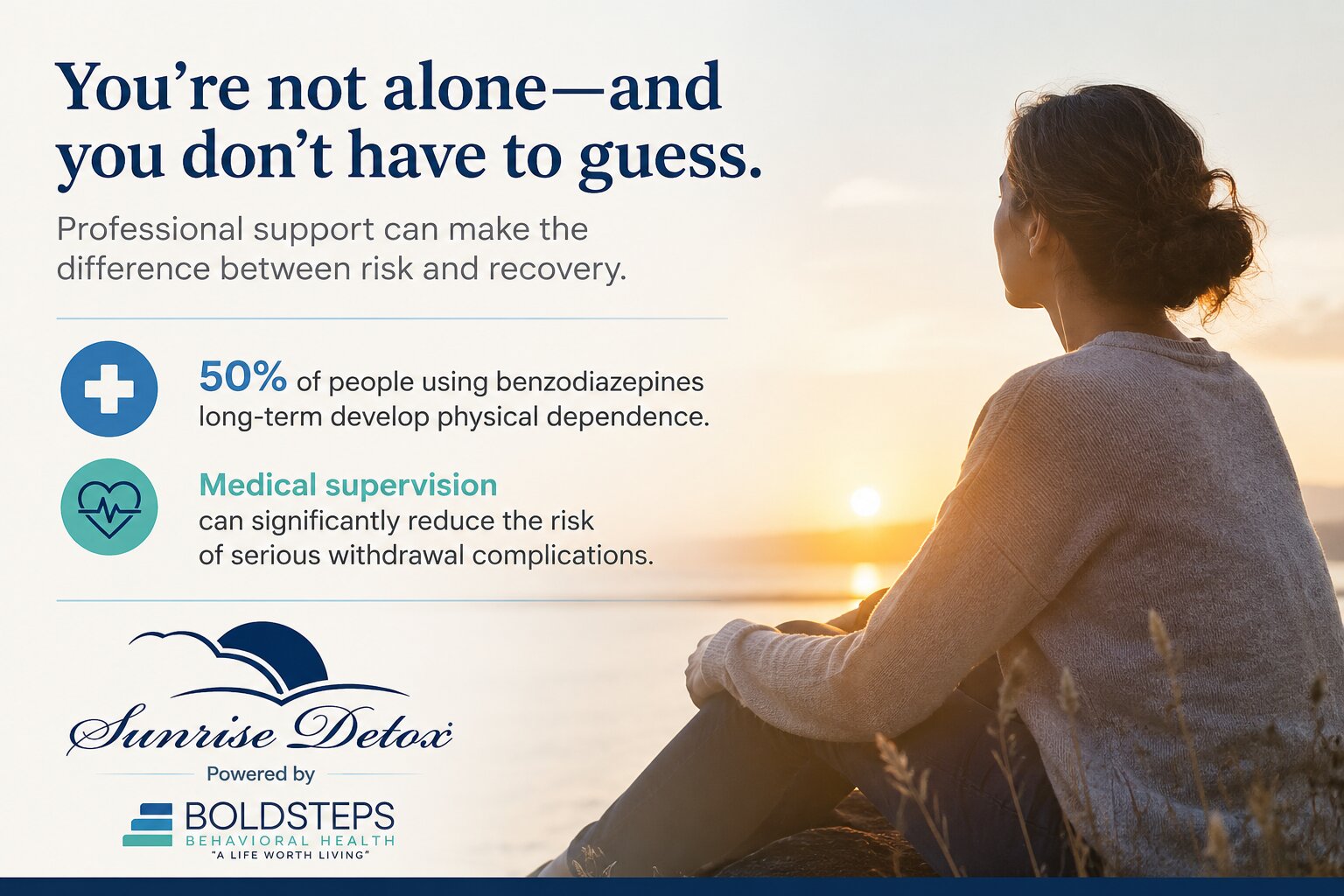
Unlike many medications, benzodiazepines can create physical dependence over time.
That doesn’t mean someone has done something wrong.
It doesn’t mean they’re addicted.
It simply means the body may have adapted to the medication’s presence.
When that happens, suddenly removing the medication can create a reaction.
The difficulty is that reactions vary significantly from person to person.
Some people experience relatively mild symptoms.
Others experience symptoms that become increasingly difficult to manage.
The challenge is that there is no reliable way to predict exactly how withdrawal will affect someone without understanding their individual circumstances.
This uncertainty is often what makes people nervous.
And honestly, it should be taken seriously.
How Does Someone Know If Withdrawal Might Be Risky?
This is one of the most important questions a person can ask.
Several factors can influence risk, including:
- Length of use
- Dosage
- Frequency of use
- Age
- Medical history
- Mental health history
- Use of other substances
- Previous withdrawal experiences
Someone who has taken Ativan regularly for a long period of time may face different risks than someone who used it briefly.
Likewise, someone who has experienced withdrawal symptoms in the past may require additional caution.
One mistake people often make is comparing themselves to strangers online.
Just because someone else had a mild experience does not guarantee the same outcome for you.
Withdrawal is highly individual.
Is It Dangerous to Stop Suddenly?
For some individuals, yes.
This is one reason medical professionals often caution against abruptly discontinuing benzodiazepines after prolonged use.
The nervous system adapts over time.
When a medication is suddenly removed, the body may struggle to readjust.
Potential complications can include:
- Severe anxiety
- Panic symptoms
- Elevated blood pressure
- Rapid heart rate
- Intense insomnia
- Hallucinations
- Seizures
Not everyone experiences severe symptoms.
However, because serious complications are possible, medical supervision is often recommended when risk factors are present.
Think of it like removing training wheels from a bicycle.
Most people would not remove them while speeding downhill.
The safest approach is usually gradual, controlled, and supported.
What Symptoms Are Considered Normal?
Many people experience symptoms that, while uncomfortable, are relatively common during withdrawal.
These may include:
- Anxiety
- Restlessness
- Irritability
- Difficulty sleeping
- Increased sweating
- Headaches
- Muscle aches
- Nausea
- Trouble concentrating
- Heightened sensitivity to light or sound
One reason these symptoms feel particularly alarming is because they often resemble the original anxiety symptoms that led someone to take Ativan in the first place.
This creates confusion.
People wonder:
“Is my anxiety returning?”
“Is this withdrawal?”
“Am I getting worse?”
Without guidance, it can be difficult to know.
That uncertainty often increases fear, which can make symptoms feel even more intense.
When Should Someone Seek Immediate Medical Attention?
Certain symptoms should never be ignored.
Emergency medical attention may be necessary if someone experiences:
- Seizures
- Hallucinations
- Severe confusion
- Loss of consciousness
- Chest pain
- Extreme disorientation
- Significant changes in awareness
- Thoughts of self-harm
These symptoms go beyond normal discomfort and may indicate a serious medical situation.
If any of these occur, immediate professional evaluation is essential.
You do not need to “wait and see” if things improve.
Safety comes first.
Why Do So Many People Try to Handle It Alone?
The answer is rarely stubbornness.
More often, it’s fear.
Some people worry about being judged.
Others fear missing work.
Some are concerned about family responsibilities.
Others simply don’t want to admit they’re struggling.
We’ve spoken with people who spent months researching before making a single phone call.
Not because they didn’t care.
Because they cared deeply and wanted to make the right decision.
Fear often sounds like logic.
It says:
“Maybe it’s not serious enough.”
“Maybe I should wait.”
“Maybe I can push through.”
Sometimes those thoughts are accurate.
Sometimes they become barriers that delay help longer than necessary.
Is There a Difference Between Being Uncomfortable and Being Unsafe?
Absolutely.
And this distinction matters.
Withdrawal is often uncomfortable.
That does not automatically mean it is dangerous.
However, the challenge is that people experiencing symptoms are not always in the best position to judge where that line exists.
Imagine trying to assess a storm while standing in the middle of it.
Everything feels intense.
Everything feels urgent.
Professional assessment helps determine whether symptoms are expected, whether additional support would be helpful, and whether safety concerns exist.
That perspective can be incredibly valuable.
What If I Have a Job or Family Responsibilities?
This concern comes up frequently.
People worry that seeking help will completely disrupt their lives.
The reality is that many individuals delay getting support because they are trying to protect work, family, and responsibilities.
Ironically, unmanaged withdrawal symptoms often create even greater disruption.
When sleep disappears, anxiety escalates, and physical symptoms worsen, everyday responsibilities become more difficult to manage.
Seeking support isn’t about abandoning responsibilities.
It’s often about protecting them.
What About Ativan Withdrawal at Home?
Many people search online for information about ativan withdrawal at home because they hope they can manage the process independently.
That desire is understandable.
Most people want the simplest path possible.
However, withdrawal does not always follow a predictable path.
Symptoms can change.
They can intensify.
And they can sometimes become more serious than initially expected.
Because risk varies from person to person, professional evaluation can help determine whether home management is appropriate or whether additional medical support would provide a safer experience.
The goal is not to make withdrawal harder.
The goal is to make it safer.
What If I’m Not Ready to Commit to Treatment?
That’s okay.
Many people assume they must make a major decision immediately.
You don’t.
The first step is often information.
You can ask questions.
You can learn about your options.
You can explore what support looks like.
You can gather facts before making any commitments.
In many cases, simply having an honest conversation reduces anxiety because uncertainty begins to fade.
Knowledge has a way of making difficult decisions feel more manageable.
Why Is Early Action Often Easier Than Waiting?
Many people spend months—or years—hoping concerns will resolve themselves.
Sometimes they do.
Often they don’t.
The earlier someone gathers information, the more options they typically have.
Waiting for symptoms to worsen rarely creates more choices.
It usually creates fewer.
You don’t need to wait until everything feels unmanageable.
You don’t need to reach a breaking point.
You don’t need a crisis to justify asking questions.
A concern is enough.
Frequently Asked Questions
How long does Ativan withdrawal last?
The timeline varies from person to person. Factors such as dosage, duration of use, metabolism, and overall health can influence how long symptoms persist.
Can Ativan withdrawal be life-threatening?
In some cases, serious complications such as seizures can occur. This is one reason professional medical guidance is often recommended.
Is it safe to stop Ativan cold turkey?
Abruptly stopping benzodiazepines after regular use can increase withdrawal risks. Professional medical guidance is generally advised before making significant changes.
What is the most common withdrawal symptom?
Anxiety, insomnia, restlessness, and irritability are among the most commonly reported symptoms.
How do I know if I need medical detox?
A professional assessment can help determine risk factors and identify whether medical monitoring would be beneficial for your situation.
Can withdrawal affect sleep?
Yes. Difficulty falling asleep, staying asleep, or experiencing restful sleep is extremely common during withdrawal.
What if I’ve only been taking Ativan as prescribed?
Dependence can sometimes develop even when medications are used exactly as directed. Seeking guidance does not mean you’ve done anything wrong.
Will asking questions commit me to treatment?
No. Gathering information simply helps you understand your options. Many people begin by having conversations before making any decisions.
You Don’t Have to Guess
When it comes to withdrawal, uncertainty can feel overwhelming.
The good news is that you don’t have to figure everything out by yourself.
Getting answers today may help you make safer decisions tomorrow.
Call 856-276-0873 or visit our benzodiazepine detox treatment to learn more about our Benzodiazepine Detox services Philadelphia.