


For a long time, I told myself I was being responsible.
I wasn’t avoiding treatment.
I was researching.
At least that’s what I said.
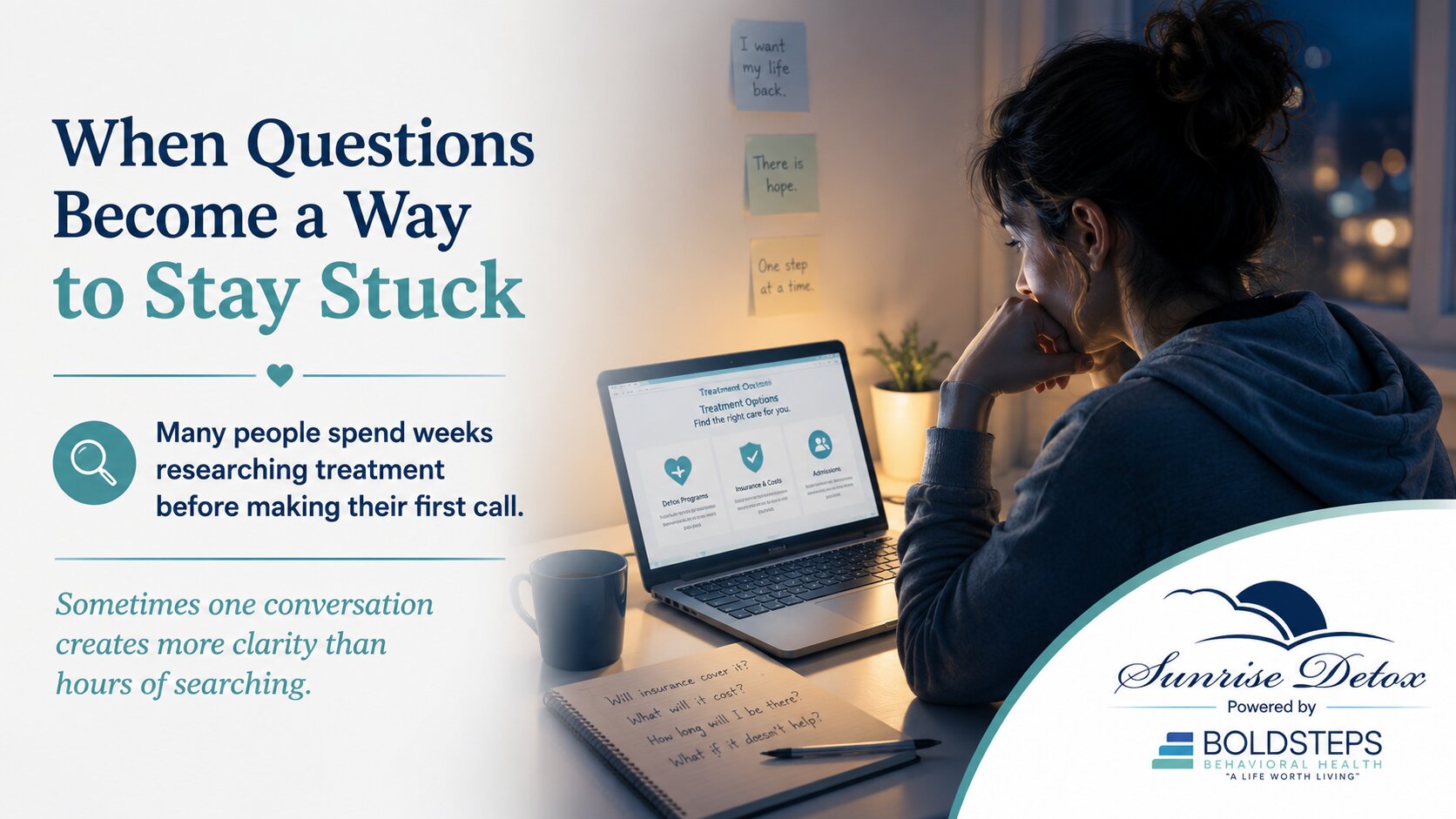
I compared facilities. I read reviews. I searched insurance information late at night. I opened the same websites over and over again. I looked at coverage details, benefits information, and admission pages.
I convinced myself I was making progress.
But if I’m being honest, I wasn’t moving forward.
I was standing still.
The questions felt productive because they gave me something to do besides making a decision.
And if you’ve been searching for answers while considering opioid recovery support, I want you to know something that took me a long time to learn:
Sometimes the questions are not the obstacle.
Sometimes they become the hiding place.
I Knew I Needed Help Before I Started Looking for Insurance Answers
The funny thing is that I already knew I needed help.
I knew it months before I started researching treatment.
Maybe even years.
I knew because my life had become smaller.
Not dramatically smaller.
Quietly smaller.
I stopped making plans that didn’t revolve around opioids.
I worried constantly about running out.
I monitored prescriptions.
I planned trips around access.
I measured time differently than I used to.
Most people schedule their days around responsibilities.
I scheduled mine around avoiding withdrawal.
When I finally started researching treatment, it wasn’t because I had suddenly discovered a problem.
It was because I had finally stopped pretending there wasn’t one.
Every Search Felt Like Progress
If you’ve ever found yourself going down a late-night Google rabbit hole, you know exactly what I mean.
You search one question.
Then another.
Then five more.
Soon you’ve spent three hours reading information and somehow feel further from a decision than when you started.
That’s exactly what happened to me.
I searched everything.
Would treatment be covered?
Would I qualify?
Would there be out-of-pocket costs?
Would insurance approve detox?
Would I need referrals?
Would there be waiting periods?
The list never ended.
Every answer created three new questions.
Looking back, I wasn’t searching for information.
I was searching for certainty.
And certainty is a dangerous thing to wait for because it rarely arrives.
The Fear Had Nothing to Do With Insurance
This realization hit me much later.
At the time, I genuinely believed insurance was my biggest concern.
I worried about cost.
I worried about coverage.
I worried about paperwork.
But underneath those concerns was something deeper.
Fear.
Not financial fear.
Personal fear.
Getting answers meant getting closer to action.
Getting closer to action meant getting closer to change.
And change felt terrifying.
Insurance questions became a shield.
As long as I was still researching, I didn’t have to commit.
As long as I was still gathering information, I didn’t have to admit how scared I was.
I suspect many people reading this understand exactly what I mean.
The Cost of Waiting Was Higher Than I Realized
One thing nobody tells you is that addiction charges interest.
Not financial interest.
Life interest.
The longer I waited, the more energy I lost.
The more relationships suffered.
The more exhausted I became.
The more my confidence disappeared.
The strange thing is that I was obsessing over potential treatment costs while completely ignoring the cost of staying stuck.
I was worried about what treatment might require.
I wasn’t paying attention to what addiction was already taking.
Time.
Peace of mind.
Trust.
Freedom.
Energy.
Presence.
The bill was arriving every day.
I just wasn’t calling it a bill yet.
The Call I Avoided for Months
I can still remember staring at my phone.
The number was right there.
I had visited the website countless times.
I had already read every page.
I knew more about the facility than some people who actually worked there.
Yet I couldn’t bring myself to call.
Why?
Because making the call would make everything real.
Research was theoretical.
A conversation was real.
A conversation meant admitting I needed help.
A conversation meant somebody else would know.
A conversation meant I could no longer hide behind unanswered questions.
I wish I could tell you I felt brave when I finally called.
I didn’t.
I felt nervous.
I felt uncertain.
I felt embarrassed.
But I called anyway.
And that changed everything.
The Conversation Was Nothing Like I Expected
One of the biggest surprises was how simple the conversation felt.
Nobody expected me to understand insurance terminology.
Nobody expected me to have every answer.
Nobody treated me like a burden.
They simply listened.
They answered questions.
They explained next steps.
They helped me understand what options were available.
Most importantly, they helped reduce the uncertainty that had been keeping me stuck.
What I learned that day was that asking questions directly is very different from endlessly searching for answers alone.
One moves you forward.
The other often keeps you trapped.
Why Insurance Questions Feel So Heavy
Insurance questions carry emotional weight because they represent more than logistics.
They represent possibility.
If coverage exists, treatment suddenly feels real.
If treatment feels real, recovery feels possible.
If recovery feels possible, then the future might actually look different.
That’s a lot of pressure for a single phone call.
Many people are not just asking about insurance.
They’re asking whether change is actually within reach.
They’re asking whether hope is realistic.
They’re asking whether they can finally stop living the way they’ve been living.
Those are big questions.
No wonder the process feels overwhelming.
The Searches I Made at Two in the Morning
I remember searching phrases related to treatment coverage over and over again.
I wanted reassurance.
I wanted certainty.
I wanted someone to tell me exactly how everything would unfold.
One of the searches I made involved questions related to opioid treatment Horizon BCBS because I was desperate to understand what treatment might actually look like financially.
But eventually I realized something important.
Google could only take me so far.
At some point, I had to stop searching and start talking.
That shift changed the entire process.
Recovery Started Before Treatment Did
Looking back, I think recovery started earlier than I realized.
It didn’t begin when I entered treatment.
It began when I stopped using uncertainty as an excuse.
It began when I admitted that fear was making decisions for me.
It began when I accepted that I didn’t need perfect information to take the next step.
Recovery often starts with honesty.
Not sobriety.
Honesty.
Honesty about how bad things have become.
Honesty about what isn’t working.
Honesty about what you’re afraid of.
That was the real beginning for me.
What I Wish I Could Tell the Person Still Searching
If you’re reading this while bouncing between websites, comparing facilities, checking insurance information, and wondering whether you should call, I want to tell you what I wish someone had told me.
Your questions are valid.
Your concerns are understandable.
Your hesitation makes sense.
But don’t confuse preparation with progress.
There comes a point when more research stops helping.
There comes a point when another search result won’t provide the answer you’re actually looking for.
Sometimes the answer arrives through a conversation.
Sometimes it arrives through action.
And sometimes the next step is much smaller than you think.
Not treatment.
Not a major commitment.
Not a life-changing decision.
Just a phone call.
Just a question.
Just a conversation.
That’s how it started for me.
The Future Felt Less Scary Once I Started Moving
The irony is that the future felt terrifying when I was standing still.
Once I started taking steps, things became clearer.
Not easier overnight.
Not perfect.
But clearer.
I finally had information based on my actual situation instead of assumptions.
I finally had people helping me navigate the process.
I finally stopped carrying the entire burden alone.
The questions didn’t disappear.
But they stopped controlling my decisions.
And that made all the difference.
Frequently Asked Questions
Do I need to understand my insurance benefits before reaching out?
No. Many people contact treatment providers before fully understanding their coverage. The admissions process often includes helping individuals understand available benefits and next steps.
What if I’m worried treatment will be too expensive?
Financial concerns are extremely common. Speaking directly with a provider can help clarify coverage details and available options rather than relying on assumptions.
Can insurance questions delay recovery?
Yes. While coverage questions are important, some people unintentionally use uncertainty as a reason to postpone seeking help.
Is it normal to feel overwhelmed by the process?
Absolutely. Treatment decisions often involve emotional, financial, and personal concerns. Feeling overwhelmed does not mean you’re making the wrong decision.
Why do I keep researching but struggle to take action?
Many people are not just seeking information. They’re managing fear, uncertainty, and the emotional reality of making a significant life change.
What if I’m not completely sure I need treatment?
You don’t need complete certainty to ask questions. Speaking with a professional can help you better understand your situation and available options.
What’s the first step?
For many people, the first step is simply reaching out and having a conversation. You don’t need to have everything figured out before making that call.
You Don’t Have to Figure Everything Out Alone
If you’ve spent weeks or months researching insurance questions while wondering whether treatment is possible, you’re not alone. Many people find themselves caught between needing help and wanting certainty first. The good news is that you don’t need every answer before taking the next step.
Call (856) 276-0873 or learn more about our opioid recovery support to explore our Opiate Detox services and begin moving forward with confidence.