


A parent recently described one of the longest nights of their life.
Their son had come home after spending time with friends. At first, nothing seemed unusual. Then he started pacing around the house. He sat down, stood back up, walked into another room, and returned a few minutes later.
Finally, he looked at his mother and asked a question she would never forget.
“Why won’t my heart slow down?”
She could see the fear in his face.
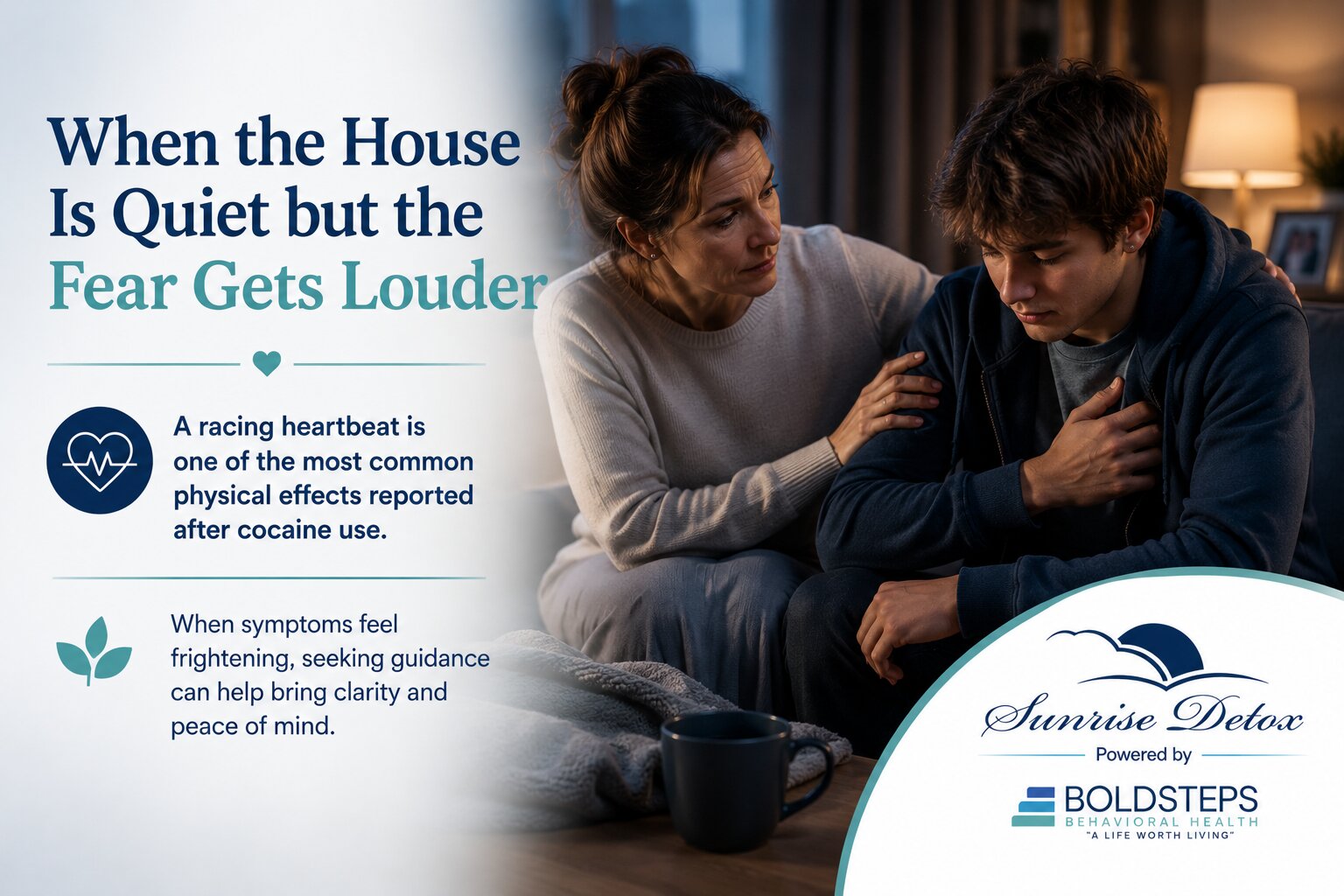
He was sweating. He seemed restless. Every few minutes he placed his hand on his chest as if checking whether his heart was still beating too fast.
As a parent, moments like this can feel overwhelming. Your mind immediately jumps to worst-case scenarios. You wonder whether you should call 911. You wonder whether this is temporary. You wonder whether your child is in real danger.
If you’re reading this because your son or daughter recently experienced a pounding heartbeat after cocaine use, know that you are not alone.
Many families first begin seeking answers after a frightening physical symptom appears. If cocaine use has become a concern, learning more about cocaine detox support can help you understand what professional care may look like and what options may be available.
Sometimes the Scariest Part Is Not Knowing What’s Happening
Fear grows in uncertainty.
Most parents have at least a basic understanding that cocaine can be dangerous. What many do not expect is how intense the physical symptoms can feel, even after what someone describes as “just a few lines.”
A young adult may suddenly complain that their heart is pounding. They may appear anxious, shaky, agitated, or unable to relax.
For parents, the uncertainty can be agonizing.
Is this anxiety?
Is this a panic attack?
Will it pass?
Should I be taking them to the hospital?
When answers are unclear, every minute can feel much longer than it really is.
Why Cocaine Can Cause a Pounding Heartbeat
Cocaine is a stimulant.
It affects the body’s nervous system by increasing activity in ways that can temporarily create feelings of energy, confidence, and alertness.
At the same time, it can place significant stress on the heart and blood vessels.
As heart rate increases, many people become hyperaware of every beat. What starts as a fast heartbeat can quickly trigger fear, which causes additional adrenaline to be released. That fear can make symptoms feel even stronger.
The result can become a cycle.
The heart beats faster.
The person becomes scared.
The fear increases physical symptoms.
The stronger symptoms create even more fear.
For someone already feeling vulnerable, that cycle can become extremely distressing.
This is one reason searches related to heart racing after party drugs are so common. Many people are frightened by symptoms they did not expect and begin searching for reassurance in the middle of the night.
Why Some Young Adults Become Afraid to Sleep
One of the most common concerns families describe is a fear of falling asleep.
A young adult may repeatedly say things like:
“What if something happens while I’m asleep?”
“What if my heart stops?”
“What if I don’t wake up?”
These fears are often fueled by the intense physical sensations they are experiencing.
Every heartbeat feels louder.
Every sensation feels magnified.
Every minute feels important.
Even though exhaustion may set in, the body often struggles to relax. It can feel like trying to sleep while an alarm is still going off inside the nervous system.
Parents frequently find themselves sitting nearby, watching and worrying, unsure whether they should leave the room or stay awake all night.
The emotional weight of that experience is real.
Signs That Immediate Medical Attention May Be Needed
While some symptoms may improve as the effects of cocaine wear off, certain warning signs should never be ignored.
Seek emergency medical care immediately if your loved one experiences:
- Severe chest pain
- Difficulty breathing
- Loss of consciousness
- Seizures
- Extreme confusion
- Hallucinations
- Blue or gray skin coloration
- Sudden collapse
- Signs of stroke such as facial drooping or difficulty speaking
Parents sometimes hesitate because they fear overreacting.
In situations involving cocaine use and significant cardiovascular symptoms, it is always better to prioritize safety.
If something feels seriously wrong, trust your instincts and seek emergency help.
What Parents Can Do in the Moment
When emotions are high, it can be difficult to know how to respond.
Many parents immediately begin asking questions.
How much did you take?
Where did you get it?
Who were you with?
Those questions are understandable. However, during an active crisis, the most important goal is stabilization and safety.
Try to remain calm.
Speak slowly.
Offer reassurance without making promises you cannot guarantee.
Encourage your loved one to avoid taking additional substances in an attempt to calm themselves down.
Stay present.
Sometimes your calm presence becomes the anchor that helps them navigate a frightening experience.
Think of yourself as a lighthouse during a storm. You cannot stop the waves, but your steady presence can help guide someone through them.
What This Moment May Be Trying to Tell You
Many families initially focus only on the immediate symptom.
The pounding heartbeat.
The panic.
The fear.
But sometimes that symptom becomes the event that finally reveals a larger concern.
Parents often tell us they had noticed subtle changes before the crisis.
Maybe their child had become more withdrawn.
Maybe their sleep schedule changed.
Maybe money seemed to disappear more quickly.
Maybe they became defensive when asked simple questions.
None of those signs felt definitive on their own.
Then one frightening night brought everything into focus.
A crisis does not automatically mean addiction is present.
However, it can be an important signal that further evaluation and support may be needed.
Recovery Conversations Do Not Need to Be Perfect
Parents often place enormous pressure on themselves.
They believe they must find the perfect words.
They rehearse conversations repeatedly.
They worry about saying the wrong thing.
In reality, recovery conversations are rarely perfect.
The goal is not perfection.
The goal is connection.
Simple statements are often the most powerful.
“I was scared when I saw what happened.”
“I love you.”
“I’m worried about you.”
“I want to help.”
Those words may not solve everything immediately.
But they create an opening.
And openings matter.
Many people begin accepting help not because someone delivered a perfect speech, but because someone consistently showed compassion and concern.
There Is Hope Beyond This Night
When parents witness a behavioral health crisis, it is easy to believe the future will always feel this frightening.
But recovery stories often begin in moments that feel exactly like this.
A late-night conversation.
A frightening symptom.
A moment of honesty.
A realization that something needs to change.
The path forward may not be immediate.
It may not be straightforward.
But help exists, and people recover every day.
The night that fills a family with fear can also become the night that starts a different chapter.
Frequently Asked Questions
Is a pounding heartbeat normal after cocaine use?
A rapid or pounding heartbeat is a common reaction to cocaine because the drug stimulates the cardiovascular system. However, severe symptoms should never be ignored, especially when accompanied by chest pain, breathing difficulties, or confusion.
How long can a racing heartbeat last after cocaine use?
The experience varies from person to person. Factors such as the amount used, overall health, and whether other substances were involved can influence how long symptoms last. Persistent or worsening symptoms should be evaluated by medical professionals.
Should I let my child sleep if their heart is pounding?
If symptoms appear severe or concerning, medical evaluation should be sought immediately. If you are unsure whether symptoms are dangerous, contacting emergency services or seeking urgent medical care is the safest option.
Can anxiety make the symptoms feel worse?
Yes. Fear and panic can intensify physical sensations and make a rapid heartbeat feel even more pronounced. However, symptoms should never automatically be dismissed as anxiety alone.
When should a family consider professional treatment?
If cocaine use is becoming repetitive, difficult to stop, or causing physical, emotional, academic, legal, or relationship problems, professional evaluation may help determine appropriate next steps.
Can someone recover from cocaine addiction?
Yes. Many people successfully recover with the right support, treatment, and ongoing care. Recovery often begins with recognizing that help may be needed and taking the first step toward it.
You Do Not Have to Navigate This Alone
Watching a young adult experience a pounding heartbeat after cocaine use can be frightening. Many parents feel overwhelmed, helpless, and unsure what to do next. The good news is that support is available, and recovery is possible.
Call (856) 276-0873 or learn more about our cocaine detox support to explore how professional care may help your loved one take the next step toward recovery.