


I remember staring at my phone one afternoon, scrolling through treatment websites and closing them almost as quickly as I opened them.
Not because I didn’t need help.
Because I wasn’t sure I believed in it anymore.
I’d already done the treatment thing. I’d sat in groups, listened to counselors, made promises to myself, and left feeling hopeful. Then life happened. Drinking crept back in. Slowly at first, then all at once.
The hardest part wasn’t the drinking. It was the disappointment.
If you’re searching for alcohol detox near Philadelphia right now, there’s a good chance you’re carrying some of that same disappointment. Maybe you’ve tried treatment before. Maybe someone you love convinced you to go once and it didn’t stick. Maybe you’re tired of hearing people tell you to “just get help” as if it’s that simple.
Before you decide what comes next, it might help to look at treatment through a different lens.
For many people, the next step begins by exploring available options for medical detox and recovery support and figuring out what makes sense today rather than comparing every possibility to a previous experience.
Sometimes Treatment Didn’t Fail—Life Got Loud Again
One of the biggest misconceptions about addiction treatment is that success means never struggling again.
Most people don’t apply that standard anywhere else in life.
If someone attends physical therapy after a knee injury and experiences pain again later, we don’t say therapy failed. We recognize that recovery often requires ongoing support, adjustments, and sometimes additional care.
Alcohol recovery works similarly.
Many people leave treatment feeling stronger than they did when they arrived. They learn valuable skills, gain insight into their drinking, and build momentum. But eventually they return to jobs, stress, relationships, financial pressures, and environments that haven’t changed.
When drinking starts again, it’s easy to look back and decide the entire experience was pointless.
That’s rarely the full story.
Sometimes treatment helped more than you realize. It just wasn’t the end of the story.
The Weight of Starting Over
There’s a unique kind of embarrassment that comes with considering treatment again.
You start imagining what everyone else will think.
Maybe your family supported you the first time and you worry they’ll see another attempt as proof that nothing works.
Maybe your friends think you’re doing fine.
Maybe you’ve spent months pretending things are under control.
The idea of admitting you need help again can feel exhausting.
I know people who spent more energy hiding their struggles than they spent addressing them.
That’s one of addiction’s cruel tricks. It convinces you that maintaining appearances matters more than feeling better.
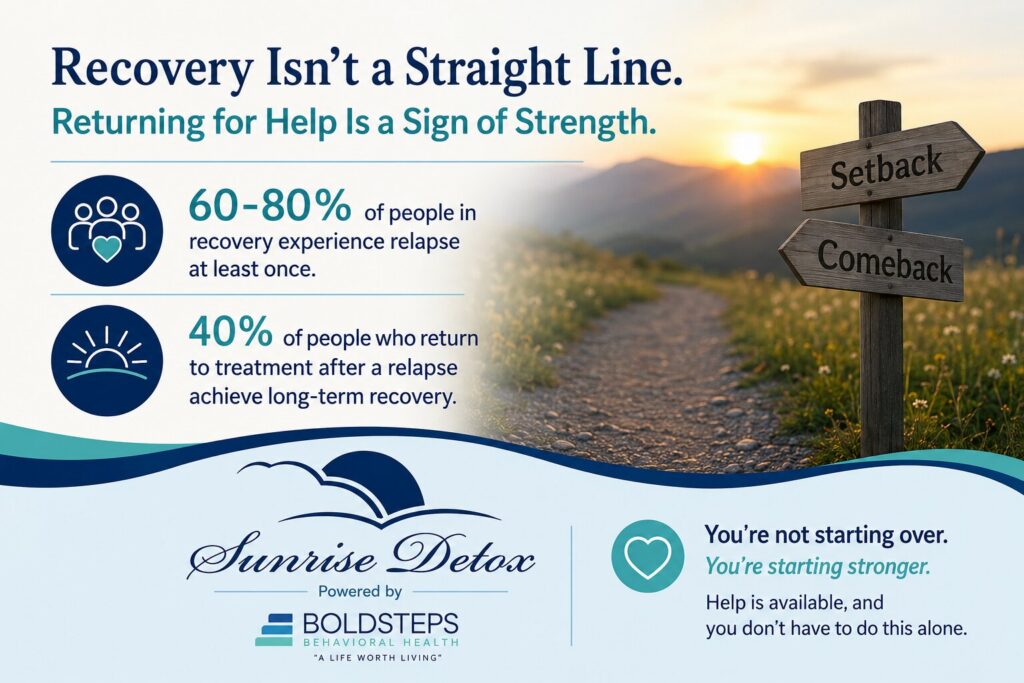
The truth is that many people entering treatment aren’t first-timers. Returning for help is far more common than most people realize.
Recovery isn’t a straight line. Most people know that intellectually. It’s much harder to accept when it’s your own life.
The Search Usually Starts Before the Crisis
People often imagine that treatment begins after a dramatic event.
A DUI.
A lost job.
A health emergency.
A family intervention.
Those things happen. But many admissions start somewhere much quieter.
It starts with noticing that alcohol occupies more mental space than it used to.
It starts with waking up anxious and immediately thinking about drinking.
It starts with promising yourself you’ll only have a few drinks and breaking that promise again.
It starts with feeling tired all the time.
Not physically tired.
Soul tired.
The kind of tired that comes from carrying the same secret every day.
Many people searching for treatment options in the Philadelphia area haven’t hit a stereotypical rock bottom. They’re simply exhausted by the effort required to keep everything together.
And sometimes that exhaustion becomes the reason they finally make a call.
Why Timing Matters More Than Most People Think
One thing I’ve learned from people in recovery is that willingness doesn’t always arrive with fireworks.
It often arrives quietly.
You wake up one morning and think:
“I can’t keep doing this.”
Not forever.
Not next year.
Not someday.
Just not today.
That moment matters.
Because motivation tends to come and go. Fear returns. Doubt gets louder. The voice that says “it’s not that bad” starts making arguments again.
That’s one reason many people specifically look for same day alcohol detox options. They aren’t necessarily looking for convenience. They’re trying to act while they still feel ready.
The window between wanting help and talking yourself out of it can be surprisingly small.
Quick access can make the difference between taking action and postponing it for another month.
Or another year.
You Don’t Have to Believe Recovery Will Work
This might sound strange coming from someone talking about treatment, but you don’t have to feel optimistic.
You don’t have to be inspired.
You don’t have to believe everything is going to be different this time.
A lot of people call treatment centers while feeling skeptical.
Some are angry.
Some are numb.
Some are convinced they’ll end up drinking again eventually.
The important thing isn’t whether you feel hopeful.
The important thing is whether you’re willing to explore another possibility.
Skepticism doesn’t disqualify you from recovery.
In fact, many people who eventually build lasting sobriety begin from a place of doubt.
They simply stay open long enough to learn something new.
Maybe the Question Has Changed
After a disappointing experience, people often ask:
“Will treatment work this time?”
It’s understandable.
But it may not be the most useful question.
A different question might be:
“What do I need now that I didn’t have before?”
Maybe you need stronger medical support during withdrawal.
Maybe you need a treatment environment that feels different from what you’ve experienced before.
Maybe you need more honesty about how much alcohol is affecting your life.
Maybe you need support that continues after detox.
Growth often begins when the questions change.
And sometimes the answer isn’t that treatment failed.
It’s that your needs have changed.
There Is No Prize for Waiting Longer
One of the biggest myths surrounding addiction is that people need to hit a certain level of suffering before seeking help.
That’s simply not true.
You don’t have to lose everything.
You don’t have to wait for a crisis.
You don’t have to prove how bad things are.
If alcohol is making your life smaller, harder, more stressful, or more painful than it needs to be, that’s enough reason to explore support.
No one receives an award for enduring another six months of struggle.
No one gets bonus points for waiting until things become unbearable.
The sooner someone reaches out, the more options they often have.
Frequently Asked Questions
How quickly can someone be admitted for alcohol detox?
Admission timelines vary by facility, medical needs, and availability. Some programs are able to complete assessments and admissions very quickly, which is why many people search for immediate treatment options when they’re ready to take action.
Is alcohol withdrawal dangerous?
It can be. Alcohol withdrawal affects everyone differently, but symptoms can range from mild discomfort to serious medical complications. Because of these risks, professional medical supervision is often recommended for people with significant alcohol dependence.
What if I’ve already been through treatment before?
Many people entering treatment have previous recovery experiences. A prior treatment stay doesn’t mean future treatment won’t help. In some cases, previous experiences provide valuable insight into what type of support may be most effective moving forward.
Do I need to be completely sure I want treatment before calling?
No. Many people reach out while feeling uncertain, skeptical, or conflicted. A conversation with an admissions team can help answer questions and provide information without requiring an immediate commitment.
Why do people search for same day alcohol detox?
Often because they’re trying to act during a moment of readiness. Many people know that motivation can fade quickly, so they look for programs that can help them begin the process as soon as possible.
What happens after detox?
Detox is often the first step rather than the entire recovery process. Depending on individual needs, people may continue with additional treatment, counseling, support groups, or other forms of ongoing recovery support.
If you’re searching around Philadelphia and wondering whether it’s worth reaching out again, remember this:
You don’t need certainty.
You don’t need confidence.
You don’t even need hope.
You just need enough honesty to admit that what you’re doing right now isn’t working.
For many people, exploring a program that offers same day alcohol detox becomes that next step. Not because they suddenly believe everything will change overnight, but because they’re willing to stop carrying the entire burden by themselves.
Call (856) 276-0873 or visit our Medical Drug and Alcohol Detox Center in Philadelphia to learn more about our Medical Drug and Alcohol Detox Center in Philadelphia.