


If your heart starts pounding the moment you don’t drink…
If your body feels wired but exhausted…
If nights have become something you dread instead of rest—
You’re not overreacting.
And you’re definitely not the only one quietly searching for answers at 2am.
If part of you is wondering whether it’s time to take the next step, you can start by exploring alcohol detox support. You don’t have to commit to anything yet—just understand what’s happening.
That Intense Nighttime Spiral Has a Real Cause
It often starts subtly.
You skip your usual drinks.
You expect to feel “a little off.”
But instead, your body ramps up.
Your heart beats faster than it should.
You feel hot, then cold.
Your thoughts won’t slow down, no matter how tired you are.
And the strangest part? It can feel like anxiety—but deeper. More physical. Harder to control.
This isn’t just stress.
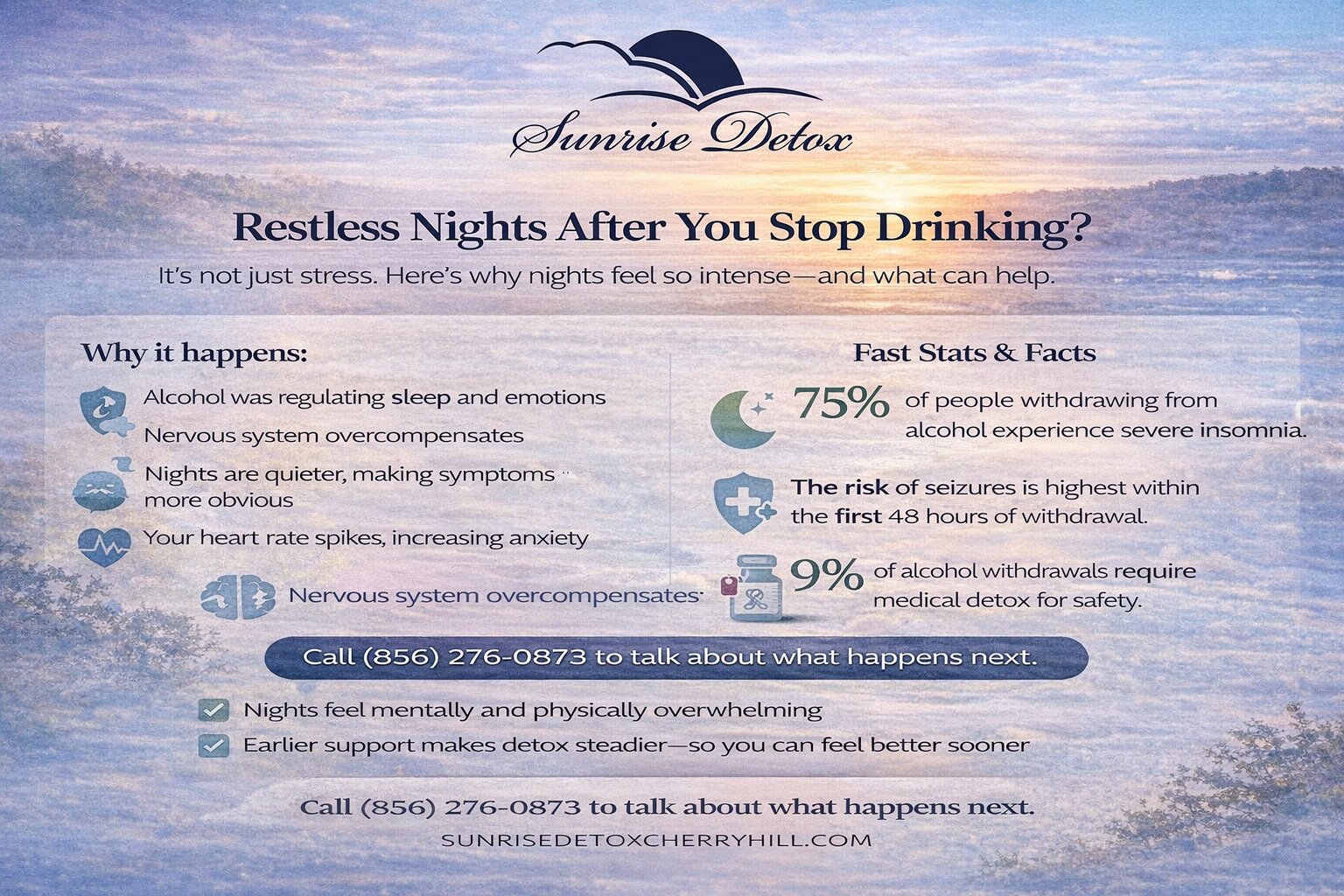
When your body gets used to alcohol, it adjusts how it regulates things like sleep, heart rate, and calmness. When alcohol suddenly isn’t there, your system doesn’t instantly reset—it overcompensates.
That’s why everything can feel turned up at once.
Why Nights Feel So Much Worse Than Days
During the day, you can distract yourself.
Work, conversations, noise—it all helps keep things manageable.
But at night?
Everything slows down.
There’s nothing to buffer what your body is feeling.
That’s when alcohol withdrawal symptoms at night tend to hit harder:
- Restlessness that won’t let you lie still
- A racing or pounding heart that feels impossible to ignore
- Sweating, chills, or that “something’s off” feeling in your skin
- A kind of alertness that feels the opposite of sleep
And because it happens in the dark, when you’re alone, it can feel bigger than it is—and more frightening.
A lot of people describe it the same way:
“It felt like something was wrong, but I didn’t know what.”
Trying to Power Through Can Make It More Intense
There’s a belief that if you’re strong enough, you can just push through a few rough nights.
That if you don’t give in, your body will sort itself out.
Sometimes that belief keeps people stuck longer than they need to be.
Because what you’re experiencing isn’t just discomfort—it’s your nervous system trying to rebalance after relying on alcohol.
And when that process isn’t supported, it can feel:
- More unpredictable
- More physically intense
- More mentally overwhelming
You might get through one night… then hit a harder one the next.
It becomes a cycle of exhaustion and uncertainty.
That doesn’t mean you’re failing.
It means your body is asking for help in a language that’s hard to ignore.
The Fear Around Detox Is Real—and Completely Normal
Let’s name it.
Thinking about detox can bring up a lot:
- Fear of how bad it might feel
- Fear of losing control
- Fear of being judged
- Fear that it won’t work
Those thoughts don’t make you resistant.
They make you human.
Most people who reach out for support feel unsure right up until they do it. There’s rarely a moment of perfect clarity where everything feels easy.
It’s usually quieter than that.
More like:
“I don’t think I can keep doing this the way I’ve been.”
And that thought is enough.
You Don’t Have to Prove How Much You Can Handle
A lot of people try to “earn” help.
They wait until symptoms get worse.
Until nights get unbearable.
Until they feel like they’ve hit some invisible threshold.
But you don’t need to prove anything.
If your body is reacting strongly—if your sleep is disrupted, your heart is racing, your system feels unstable—that’s already a valid reason to take it seriously.
You’re allowed to respond early.
In fact, it often makes everything easier.
What Support Actually Looks Like (It’s Not What You Think)
There’s a lot of misunderstanding around what getting help means.
People imagine:
- Being forced into something
- Losing control of their routine
- Being overwhelmed by the process
But in reality, support is often much more grounded.
It can mean:
- Having medical awareness around what your body is doing
- Getting help managing symptoms so they don’t escalate
- Being in a space where you don’t have to guess what’s happening
It’s not about taking over your life.
It’s about giving your body a safer way to stabilize.
There’s a Point Where Guessing Stops Helping
You can Google symptoms.
You can read stories.
You can try to piece it together on your own.
But at some point, the uncertainty becomes its own stress.
Is this normal?
Is this getting worse?
Should I be worried?
That constant guessing can keep your body on edge.
Getting clarity—even just a conversation—can take a lot of that pressure off.
Because you’re not trying to figure it out alone anymore.
You’re Closer to Change Than You Think
If you’ve made it this far—reading this, recognizing yourself in it—you’re already paying attention.
That matters more than you think.
You don’t have to make a huge decision today.
You don’t have to commit to anything all at once.
But you can take one small step:
- Learn more
- Talk to someone
- Understand your options
Sometimes, that’s enough to shift things.
FAQ: What You Might Be Wondering Right Now
Are these symptoms really related to alcohol?
They can be. When your body is used to regular drinking, stopping suddenly can trigger physical and emotional reactions—especially at night when your system tries to settle.
Why does my heart race when I don’t drink?
Alcohol affects how your nervous system regulates stress and relaxation. Without it, your body can temporarily become overactive, which may feel like a racing heart or internal restlessness.
Is it dangerous to try to stop on my own?
For some people, it can be. The intensity of symptoms varies, but certain physical reactions should be monitored. That’s why getting guidance can make a big difference.
How long do these nighttime symptoms last?
It depends on your body, your drinking patterns, and other factors. Some symptoms ease within days, while others can take longer to fully settle.
What if I’m not “that bad” yet?
You don’t need to wait until things get worse. If your body is already reacting, that’s a signal worth listening to.
What’s the first step if I’m unsure?
You don’t have to commit to treatment right away. Starting with a conversation or learning about your options can help you feel more in control of what comes next.
You Don’t Have to White-Knuckle Another Night
There’s a difference between pushing through and taking care of yourself.
One drains you.
The other supports you.
If nights have started to feel unpredictable, uncomfortable, or even a little scary—that’s not something you have to manage alone.
You deserve rest.
You deserve stability.
You deserve to feel like your body isn’t working against you.
Call (856) 276-0873 or visit our alcohol detox services to learn more about our alcohol detox services in Philadelphia.